
Japanese art on canvas
Mount Fuji and Lake Kawaguchi
Okada Kōichi · 1954
From $259 CAD
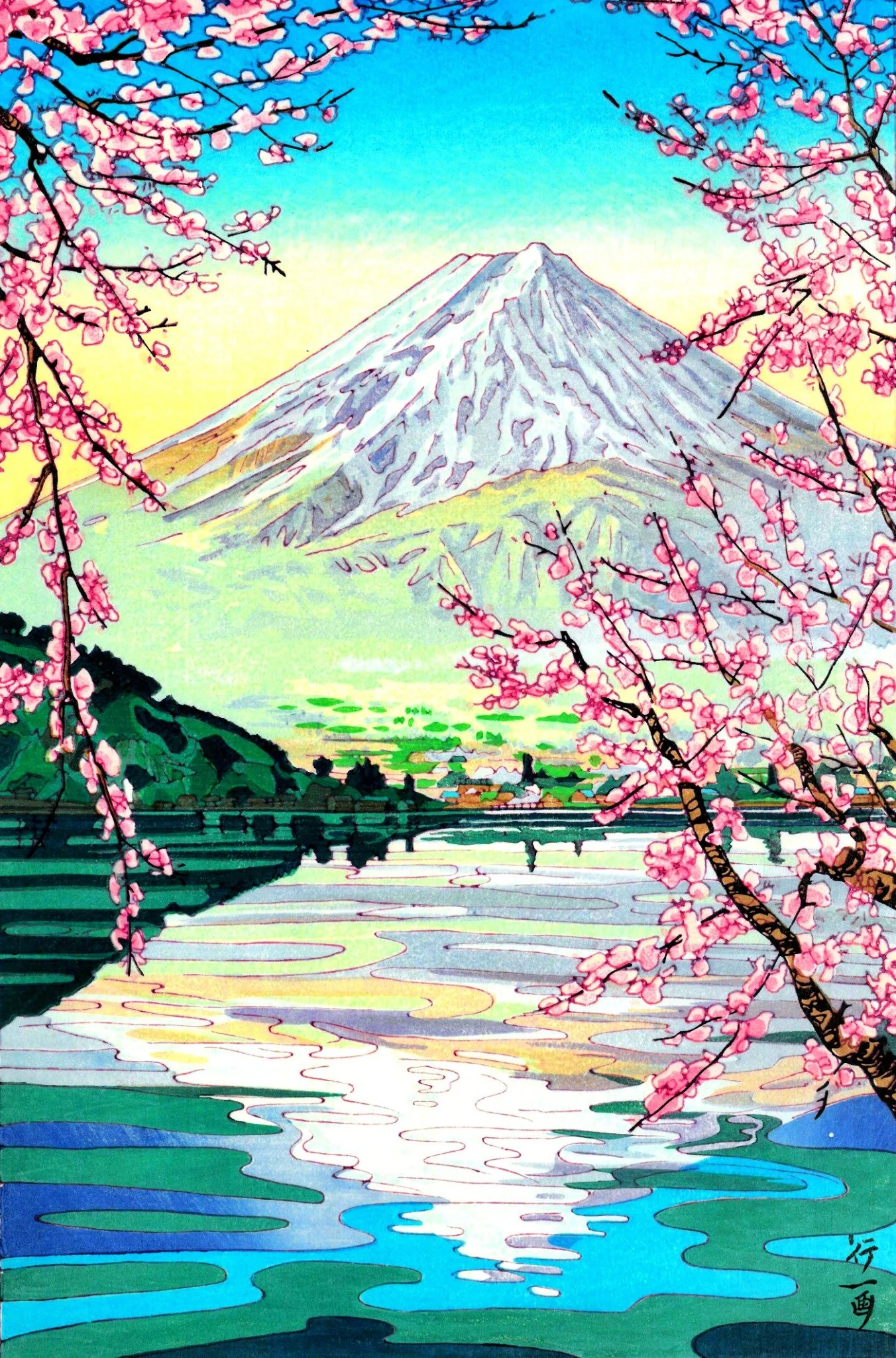
Pink cherry blossoms frame snow-covered Mount Fuji above a lake alive with turquoise, green, and golden reflections. Okada Kōichi’s Mount Fuji and Lake Kawaguchi brings the brilliance of a Japanese spring landscape into your home on portrait canvas over a sturdy 1.5-inch wood stretcher.
| 16 × 24 in. | $259 CAD |
|---|---|
| 24 × 36 in. | $299 CAD |
Choose your canvas size and quantity below. All prices are in CAD.
Artwork titles and dates identify the original work. Review the product details and available options before ordering.
Ask about this print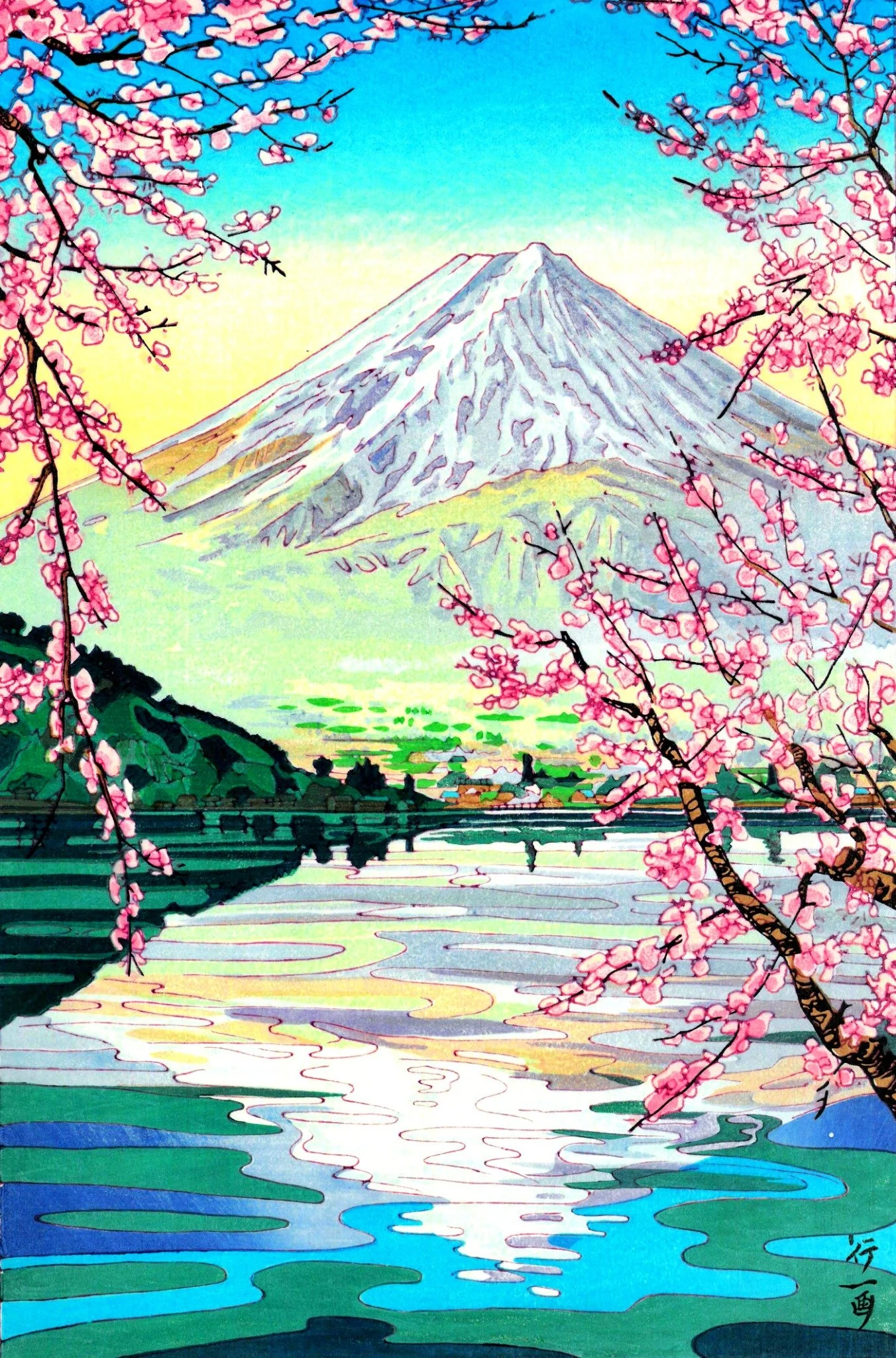
Premium quality canvas print of “Mount Fuji and Lake Kawaguchi” by Okada Kōichi
Pink cherry blossoms frame snow-covered Mount Fuji above a lake alive with turquoise, green, and golden reflections. Okada Kōichi’s Mount Fuji and Lake Kawaguchi brings the brilliance of a Japanese spring landscape into your home on portrait canvas over a sturdy 1.5-inch wood stretcher.
Product details: Canvas reproduction over a sturdy 1.5-inch wood stretcher. Available in 16 × 24 in. ($259 CAD) and 24 × 36 in. ($299 CAD). No returns accepted.
More About the Art
Mount Fuji and Lake Kawaguchi opens a brilliant spring landscape through flowering branches. Pink and white cherry blossoms enter from both sides and stretch across the upper edge, framing a snow-covered mountain beneath a clear blue sky. Below, the lake carries broad, winding bands of green, turquoise, blue, cream, and pale gold. The composition brings the delicacy of individual petals into contact with the mountain’s immense, enduring form.
Fuji rises above the centre of the view, its summit standing clear of the surrounding branches. Cool grey and lavender shapes describe its ridges, while white snow follows the channels running down its slopes. Thin pink contours connect the mountain visually with the blossoms. Near its lower reaches, softer greens and yellows spread across the land, creating a gentle transition between the pale upper mountain and the darker lakeside shore.
The branches make an intricate foreground. Their dark outlines fork into smaller twigs, supporting clusters of blossoms that vary in size and direction. Some petals appear almost white; others carry a stronger rose colour. Openings between them reveal the sky or the mountain beyond. A thicker branch curves up from the lower right, while a long, slender spray descends along the left, giving the scene an enveloping, almost sheltered viewpoint.
Water occupies much of the lower half. Its reflections unfold in long horizontal curves, with dark green shapes reaching outward from the banks and bright blue passages opening between them. A pale central reflection widens and narrows as it approaches the foreground. These smoothly bounded shapes give the lake a decorative rhythm, contrasting with the angular mountain ridges and the branching lines above. Fine surface texture remains visible within the broad areas of colour.
Across the middle distance, a low settlement stands between the lake and the mountain. Small pale roofs, warm walls, and dark trees establish a human scale without competing with the larger landscape. The shore forms a horizontal interval between the open water and Fuji’s rising slopes. Looking through the blossom frame, the eye moves from these small details toward the summit, then returns along the reflected light spreading across the lake.
The Japanese title is Kawaguchi-ko no Fuji, 河口湖の富士, meaning Fuji at Lake Kawaguchi. The publisher Unsōdō identifies the first printing of Okada Kōichi’s design as 1954. This date describes the original design’s publication history; it does not date the particular image supplied for this canvas. The work belongs to Okada’s group of twelve Japanese scenic views published by Unsōdō, many of which place Mount Fuji behind a distinctive foreground.
Lake Kawaguchi lies in Yamanashi Prefecture, where views across the water reveal Fuji’s broad slopes. The combination of mountain, lakeside trees, and changing seasons belongs to a landscape that has inspired generations of artists. Okada gives this familiar subject an especially lively presence through luminous colour and carefully enclosed space. Reproduced on portrait canvas over a sturdy 1.5-inch wood stretcher, the supplied composition offers a generous display of abundant spring blossoms, richly coloured clear water, and mountain light.
More About the Artist
Okada Kōichi (1907–1991), whose name is also written Koichi Okada, was a Japanese painter associated with a memorable group of colour woodblock landscapes published by Unsōdō. Born in Tokyo, he worked within the world of modern Japanese painting while also designing prints that give familiar scenic subjects a vivid, carefully arranged presence. Mount Fuji and Lake Kawaguchi exemplifies his ability to bring a monumental landscape close through flowering branches and richly patterned water.
Unsōdō’s biographical account identifies him as a painter trained at Bunka Gakuin. His subsequent studies included work with Ishii Hakutei, and his paintings appeared at the Teiten and later the Nitten exhibitions. He also became a member of Issuikai, an association of painters. These activities place his career within Japan’s exhibition culture as well as its print publishing tradition. The publisher records his lifespan as 1907–1991, the dates followed here.
His best-known printed work includes a series of twelve Japanese scenic views issued by Unsōdō. Many use Mount Fuji as a recurring presence while changing the nearer setting. The publisher’s catalogue includes Fuji seen with Lake Kawaguchi, Lake Ashi, the Hakone highway, and the Hagoromo coast. Considering these subjects together makes the importance of viewpoint clear: the mountain can remain recognizable while water, roads, trees, and the distance between them give each design its own character.
Unsōdō brought a substantial history of woodblock publishing to this collaboration. Founded in Kyoto in 1891, the company began as an art publisher and developed a wide range of illustrated and design books. Its work continues the skills of carving and hand printing. In this process, the artist’s drawing becomes part of a shared production: carved outlines establish the structure, and separate colour blocks build the relationships that give a finished image its depth and atmosphere.
That relationship between drawing and colour is particularly engaging in Okada’s Lake Kawaguchi view. Dark twigs remain legible within dense blossoms, while broader shapes describe snow, slopes, shoreline, and reflection. The different scales of detail work together without obscuring the overall arrangement. Viewed from across a room, the mountain and flowering frame are immediately clear. Closer attention reveals the changing contours of petals and water, encouraging the eye to move between small incidents and the wider landscape.
The continued life of these designs also involves later printing. Unsōdō explains that its later impressions use the original carved blocks, and its own catalogue distinguishes a first printing date from the reprinted sheets offered subsequently. This history helps explain why publication date and the age of an individual impression must be considered separately. The canvas offered here is a reproduction of the supplied image; its 1954 date identifies the original woodblock design’s first publication.
Okada’s approach gives a celebrated subject a distinct visual character. Fuji’s pale slopes occupy a spacious opening, while the blossoms and reflections create an intimate foreground full of movement and colour. His scenic prints invite appreciation both as recognizable places and as arrangements of line, shape, and tone. In Mount Fuji and Lake Kawaguchi, those qualities come together in a spring landscape whose brilliant colour and clear structure continue to reward an unhurried look.
Sources for the artwork and artist
Premium quality canvas print of “Mount Fuji and Lake Kawaguchi” by Okada Kōichi
Pink cherry blossoms frame snow-covered Mount Fuji above a lake alive with turquoise, green, and golden reflections. Okada Kōichi’s Mount Fuji and Lake Kawaguchi brings the brilliance of a Japanese spring landscape into your home on portrait canvas over a sturdy 1.5-inch wood stretcher.
Product details: Canvas reproduction over a sturdy 1.5-inch wood stretcher. Available in 16 × 24 in. ($259 CAD) and 24 × 36 in. ($299 CAD). No returns accepted.
More About the Art
Mount Fuji and Lake Kawaguchi opens a brilliant spring landscape through flowering branches. Pink and white cherry blossoms enter from both sides and stretch across the upper edge, framing a snow-covered mountain beneath a clear blue sky. Below, the lake carries broad, winding bands of green, turquoise, blue, cream, and pale gold. The composition brings the delicacy of individual petals into contact with the mountain’s immense, enduring form.
Fuji rises above the centre of the view, its summit standing clear of the surrounding branches. Cool grey and lavender shapes describe its ridges, while white snow follows the channels running down its slopes. Thin pink contours connect the mountain visually with the blossoms. Near its lower reaches, softer greens and yellows spread across the land, creating a gentle transition between the pale upper mountain and the darker lakeside shore.
The branches make an intricate foreground. Their dark outlines fork into smaller twigs, supporting clusters of blossoms that vary in size and direction. Some petals appear almost white; others carry a stronger rose colour. Openings between them reveal the sky or the mountain beyond. A thicker branch curves up from the lower right, while a long, slender spray descends along the left, giving the scene an enveloping, almost sheltered viewpoint.
Water occupies much of the lower half. Its reflections unfold in long horizontal curves, with dark green shapes reaching outward from the banks and bright blue passages opening between them. A pale central reflection widens and narrows as it approaches the foreground. These smoothly bounded shapes give the lake a decorative rhythm, contrasting with the angular mountain ridges and the branching lines above. Fine surface texture remains visible within the broad areas of colour.
Across the middle distance, a low settlement stands between the lake and the mountain. Small pale roofs, warm walls, and dark trees establish a human scale without competing with the larger landscape. The shore forms a horizontal interval between the open water and Fuji’s rising slopes. Looking through the blossom frame, the eye moves from these small details toward the summit, then returns along the reflected light spreading across the lake.
The Japanese title is Kawaguchi-ko no Fuji, 河口湖の富士, meaning Fuji at Lake Kawaguchi. The publisher Unsōdō identifies the first printing of Okada Kōichi’s design as 1954. This date describes the original design’s publication history; it does not date the particular image supplied for this canvas. The work belongs to Okada’s group of twelve Japanese scenic views published by Unsōdō, many of which place Mount Fuji behind a distinctive foreground.
Lake Kawaguchi lies in Yamanashi Prefecture, where views across the water reveal Fuji’s broad slopes. The combination of mountain, lakeside trees, and changing seasons belongs to a landscape that has inspired generations of artists. Okada gives this familiar subject an especially lively presence through luminous colour and carefully enclosed space. Reproduced on portrait canvas over a sturdy 1.5-inch wood stretcher, the supplied composition offers a generous display of abundant spring blossoms, richly coloured clear water, and mountain light.
More About the Artist
Okada Kōichi (1907–1991), whose name is also written Koichi Okada, was a Japanese painter associated with a memorable group of colour woodblock landscapes published by Unsōdō. Born in Tokyo, he worked within the world of modern Japanese painting while also designing prints that give familiar scenic subjects a vivid, carefully arranged presence. Mount Fuji and Lake Kawaguchi exemplifies his ability to bring a monumental landscape close through flowering branches and richly patterned water.
Unsōdō’s biographical account identifies him as a painter trained at Bunka Gakuin. His subsequent studies included work with Ishii Hakutei, and his paintings appeared at the Teiten and later the Nitten exhibitions. He also became a member of Issuikai, an association of painters. These activities place his career within Japan’s exhibition culture as well as its print publishing tradition. The publisher records his lifespan as 1907–1991, the dates followed here.
His best-known printed work includes a series of twelve Japanese scenic views issued by Unsōdō. Many use Mount Fuji as a recurring presence while changing the nearer setting. The publisher’s catalogue includes Fuji seen with Lake Kawaguchi, Lake Ashi, the Hakone highway, and the Hagoromo coast. Considering these subjects together makes the importance of viewpoint clear: the mountain can remain recognizable while water, roads, trees, and the distance between them give each design its own character.
Unsōdō brought a substantial history of woodblock publishing to this collaboration. Founded in Kyoto in 1891, the company began as an art publisher and developed a wide range of illustrated and design books. Its work continues the skills of carving and hand printing. In this process, the artist’s drawing becomes part of a shared production: carved outlines establish the structure, and separate colour blocks build the relationships that give a finished image its depth and atmosphere.
That relationship between drawing and colour is particularly engaging in Okada’s Lake Kawaguchi view. Dark twigs remain legible within dense blossoms, while broader shapes describe snow, slopes, shoreline, and reflection. The different scales of detail work together without obscuring the overall arrangement. Viewed from across a room, the mountain and flowering frame are immediately clear. Closer attention reveals the changing contours of petals and water, encouraging the eye to move between small incidents and the wider landscape.
The continued life of these designs also involves later printing. Unsōdō explains that its later impressions use the original carved blocks, and its own catalogue distinguishes a first printing date from the reprinted sheets offered subsequently. This history helps explain why publication date and the age of an individual impression must be considered separately. The canvas offered here is a reproduction of the supplied image; its 1954 date identifies the original woodblock design’s first publication.
Okada’s approach gives a celebrated subject a distinct visual character. Fuji’s pale slopes occupy a spacious opening, while the blossoms and reflections create an intimate foreground full of movement and colour. His scenic prints invite appreciation both as recognizable places and as arrangements of line, shape, and tone. In Mount Fuji and Lake Kawaguchi, those qualities come together in a spring landscape whose brilliant colour and clear structure continue to reward an unhurried look.
Sources for the artwork and artist
- Unsōdō / Hanga — official Mount Fuji and Lake Kawaguchi listing; Japanese title, artist, first printing in 1954 and twelve-view group
- Unsōdō — official Okada Kōichi biography; 1907–1991, training, exhibitions and later impressions from original blocks
- Unsōdō — publisher history and the traditional carving and printing process
- Unsōdō / Hanga — Fuji and Lake Ashi; another landscape in the artist’s published group
- Japan Ministry of Land, Infrastructure, Transport and Tourism — views of Mount Fuji across Lake Kawaguchi in Yamanashi
- UNESCO World Heritage Centre — Fujisan as a source of artistic inspiration and its history in Japanese landscape prints