
Japanese art on canvas
Moon at Matsushima
Kawase Hasui · 1930s
From $259 CAD
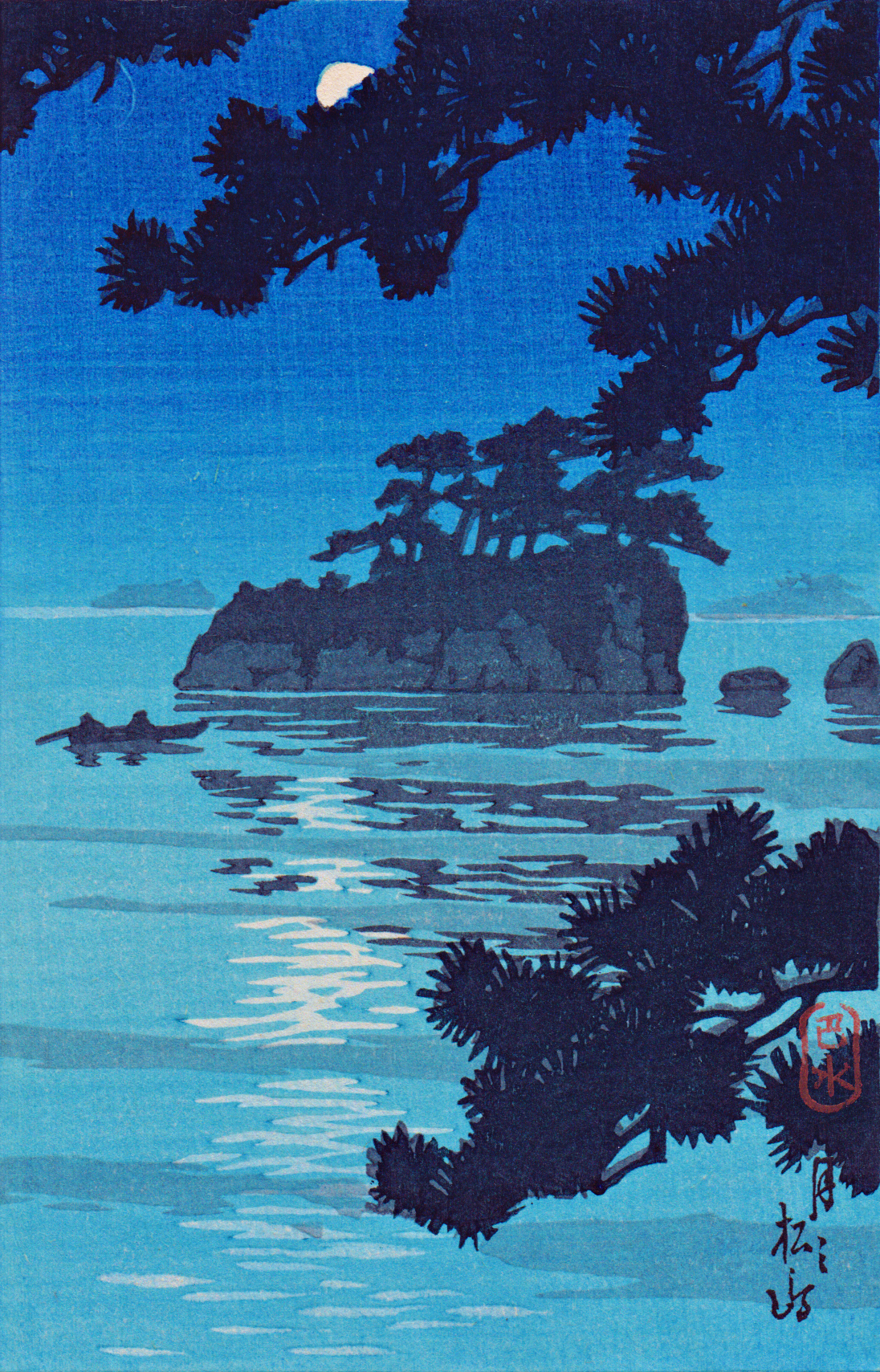
A pale moon slips between dark pine branches, laying a silver path across luminous blue water. Kawase Hasui’s Moon at Matsushima brings a quiet coastal night into your home, reproduced on canvas over a sturdy 1.5-inch wood stretcher.
| 16 × 24 in. | $259 CAD |
|---|---|
| 24 × 36 in. | $299 CAD |
Choose your canvas size and quantity below. All prices are in CAD.
Artwork titles and dates identify the original work. Review the product details and available options before ordering.
Ask about this print
Premium quality canvas print of “Moon at Matsushima” by Kawase Hasui
A pale moon slips between dark pine branches, laying a silver path across luminous blue water. Kawase Hasui’s Moon at Matsushima brings a quiet coastal night into your home, reproduced on canvas over a sturdy 1.5-inch wood stretcher.
Product details: Canvas reproduction over a sturdy 1.5-inch wood stretcher. Available in 16 × 24 in. ($259 CAD) and 24 × 36 in. ($299 CAD). No returns accepted.
More About the Art
Moon at Matsushima presents a night landscape through a close screen of pine branches. Their dark needles stretch across the upper edge and sweep inward from the lower right, opening a view of blue water and a low island. Near the top, a pale moon appears between the foliage. Below, its reflection forms a broken path of light. The scene gathers these few elements into a composition that feels intimate without losing its sense of distance.
The foreground branches establish the viewer’s position. Their dense clusters of needles are described through pointed silhouettes, with narrow gaps revealing blue sky or water behind them. Strong diagonal limbs give the upper and lower parts of the picture different rhythms. They frame the view without closing it, making the light seem something encountered through the trees rather than displayed across an unobstructed panorama.
At the centre, the island forms a dark, substantial shape above the water. Uneven rock edges support a stand of pines whose trunks and flat spreading crowns create a second, smaller pattern of branches. The island trees echo the nearer foliage, but their scale and softer detail place them farther away. Small rock forms to the right continue its shapes across the pale blue surface.
Water occupies much of the lower composition. Dark horizontal marks gather beneath the island, while lighter passages open between them. The moon’s reflection descends in irregular pale strips, widening and separating as it approaches the foreground. This broken line leads the eye down the picture, then back toward the moon. The surface feels gently active even though the larger arrangement remains still.
Colour supplies much of the scene’s atmosphere. The sky moves from a rich blue above to lighter turquoise near the distant waterline. The water is brighter still, setting the dark island and pine branches into clear relief. The moon is a small area of warm ivory within this cool palette. Rather than describing every object equally, the composition directs attention through a careful balance of bright spaces and strong silhouettes.
The Smithsonian’s National Museum of Asian Art holds a matching small-format woodblock print titled Moon at Matsushima, by Kawase Hasui and published by the S. Watanabe Color Print Co. Its collection record dates the impression to the 1930s, within the Shōwa era. The recorded image measures 14.5 by 9.3 centimetres, an intimate scale close to a postcard.
The historical work is a colour woodblock print on paper. This offering reproduces its composition on canvas, bringing the small original design into a larger setting. Its clear division of foreground branches, island, and water remains easy to follow, while the needles, reflections, and changing blues reward a closer view. The enlargement makes those visual relationships part of the room’s everyday landscape.
On a wall, Moon at Matsushima offers a quiet meeting of dark structure and luminous colour. Its appeal can begin with the expansive blue, then deepen through the small exchanges between branches and open space. The reflection gives the eye a route through the image, creating a place to pause, look outward, and return to the calm of the water.
More About the Artist
Kawase Hasui (1883–1957) was a Japanese landscape designer and an important figure in shin-hanga, the movement that renewed colour woodblock printing in the twentieth century. His subjects range from busy city districts to quiet villages, temple grounds, coastlines, and mountain scenery. Across that variety, he paid sustained attention to the way a setting changes with light and weather. Rain, snow, dusk, and moonlight are active parts of the composition, shaping what the viewer can see and the mood a place may suggest.
Born in Tokyo with the given name Bunjiro, Hasui received instruction in both Western and Japanese painting. He studied Western-style art with Okada Saburosuke and became a pupil of Kaburaki Kiyokata in 1910. Kiyokata gave him the name Hasui. This training placed him in contact with several approaches to colour, space, and pictorial design before woodblock landscapes became the centre of his career.
The work of fellow pupil Ito Shinsui helped encourage that direction. Shinsui’s Eight Views of Omi aroused Hasui’s interest in single-sheet landscape prints, and through Kiyokata he became known to publisher Watanabe Shōzaburō. Watanabe began publishing his landscapes in 1918–1919. Their association grew into a long collaboration, producing images that found audiences in Japan and overseas.
Shin-hanga brought the designer together with specialist carvers, printers, and a publisher. Hasui developed the composition, while the carving and printing stages translated its lines, shapes, and colours into impressions on paper. The publisher coordinated this shared work. The process preserved traditional craft skills while allowing new experiments in palette and expression. A print’s apparent simplicity can therefore depend on considerable collective judgment, especially where subtle changes of colour or complicated patterns of light must be made clear.
Travel supplied Hasui with subjects throughout his career. He made extensive sketching journeys across Japan during a period when many familiar places were changing through modernisation. His landscapes can record a recognisable building or location while giving equal importance to an ordinary road, a stretch of water, or the edge of a roof. These modest elements help make the image approachable: the viewer is invited into a particular view rather than given only a distant landmark.
His career also endured serious disruption. The Great Kanto Earthquake of 1923 destroyed Watanabe’s premises, woodblocks, and print stock, and Hasui lost his sketchbooks. He continued designing landscapes after those losses. Following the Second World War, he and Watanabe resumed their collaboration as demand for Japanese prints grew again, including among Americans stationed in Japan. His work developed across these changing circumstances without abandoning its close attention to landscape.
Hasui’s output extended beyond the larger landscape sheets for which he is best known. Museum exhibitions also document his work for magazines, menus, posters, and postcards. Moon at Matsushima belongs to the intimate side of this visual world: the Smithsonian’s matching impression is only 14.5 centimetres high. Its compact format still accommodates several layers of space, a clear pattern of silhouettes, and a carefully placed passage of reflected moonlight.
The importance of the printmaking craft was recognised during his later career. In 1953, Japan’s Cultural Properties Protection Committee documented the production process of Snow at Zojoji Temple. That record concerns the making of a collaborative woodblock print, preserving knowledge of how such an image came into being. Hasui continued working until the end of his life in 1957, leaving more than six hundred woodblock designs across roughly four decades.
His continuing appeal can be understood through the act of looking that his images encourage. In Moon at Matsushima, dark needles, a pale moon, a low island, and horizontal reflections hold the scene together. Each element has its own clarity, yet none needs to overwhelm the others. The landscape offers enough detail to sustain attention while leaving room for a viewer’s own memories of water, evening, and time spent beneath trees.
Sources
Takamatsu Art Museum — Travel and nostalgic landscape; collaborative printmaking
Japan Museum SieboldHuis — Kawase Hasui. Capturing the Soul of Japan
Sompo Museum of Art — Kawase Hasui: Travel and nostalgic landscape
Tokyo Fuji Art Museum — Kawase Hasui biography and 1953 process record
Museum of New Zealand Te Papa Tongarewa — Kawase Hasui’s career and landscape prints
Premium quality canvas print of “Moon at Matsushima” by Kawase Hasui
A pale moon slips between dark pine branches, laying a silver path across luminous blue water. Kawase Hasui’s Moon at Matsushima brings a quiet coastal night into your home, reproduced on canvas over a sturdy 1.5-inch wood stretcher.
Product details: Canvas reproduction over a sturdy 1.5-inch wood stretcher. Available in 16 × 24 in. ($259 CAD) and 24 × 36 in. ($299 CAD). No returns accepted.
More About the Art
Moon at Matsushima presents a night landscape through a close screen of pine branches. Their dark needles stretch across the upper edge and sweep inward from the lower right, opening a view of blue water and a low island. Near the top, a pale moon appears between the foliage. Below, its reflection forms a broken path of light. The scene gathers these few elements into a composition that feels intimate without losing its sense of distance.
The foreground branches establish the viewer’s position. Their dense clusters of needles are described through pointed silhouettes, with narrow gaps revealing blue sky or water behind them. Strong diagonal limbs give the upper and lower parts of the picture different rhythms. They frame the view without closing it, making the light seem something encountered through the trees rather than displayed across an unobstructed panorama.
At the centre, the island forms a dark, substantial shape above the water. Uneven rock edges support a stand of pines whose trunks and flat spreading crowns create a second, smaller pattern of branches. The island trees echo the nearer foliage, but their scale and softer detail place them farther away. Small rock forms to the right continue its shapes across the pale blue surface.
Water occupies much of the lower composition. Dark horizontal marks gather beneath the island, while lighter passages open between them. The moon’s reflection descends in irregular pale strips, widening and separating as it approaches the foreground. This broken line leads the eye down the picture, then back toward the moon. The surface feels gently active even though the larger arrangement remains still.
Colour supplies much of the scene’s atmosphere. The sky moves from a rich blue above to lighter turquoise near the distant waterline. The water is brighter still, setting the dark island and pine branches into clear relief. The moon is a small area of warm ivory within this cool palette. Rather than describing every object equally, the composition directs attention through a careful balance of bright spaces and strong silhouettes.
The Smithsonian’s National Museum of Asian Art holds a matching small-format woodblock print titled Moon at Matsushima, by Kawase Hasui and published by the S. Watanabe Color Print Co. Its collection record dates the impression to the 1930s, within the Shōwa era. The recorded image measures 14.5 by 9.3 centimetres, an intimate scale close to a postcard.
The historical work is a colour woodblock print on paper. This offering reproduces its composition on canvas, bringing the small original design into a larger setting. Its clear division of foreground branches, island, and water remains easy to follow, while the needles, reflections, and changing blues reward a closer view. The enlargement makes those visual relationships part of the room’s everyday landscape.
On a wall, Moon at Matsushima offers a quiet meeting of dark structure and luminous colour. Its appeal can begin with the expansive blue, then deepen through the small exchanges between branches and open space. The reflection gives the eye a route through the image, creating a place to pause, look outward, and return to the calm of the water.
More About the Artist
Kawase Hasui (1883–1957) was a Japanese landscape designer and an important figure in shin-hanga, the movement that renewed colour woodblock printing in the twentieth century. His subjects range from busy city districts to quiet villages, temple grounds, coastlines, and mountain scenery. Across that variety, he paid sustained attention to the way a setting changes with light and weather. Rain, snow, dusk, and moonlight are active parts of the composition, shaping what the viewer can see and the mood a place may suggest.
Born in Tokyo with the given name Bunjiro, Hasui received instruction in both Western and Japanese painting. He studied Western-style art with Okada Saburosuke and became a pupil of Kaburaki Kiyokata in 1910. Kiyokata gave him the name Hasui. This training placed him in contact with several approaches to colour, space, and pictorial design before woodblock landscapes became the centre of his career.
The work of fellow pupil Ito Shinsui helped encourage that direction. Shinsui’s Eight Views of Omi aroused Hasui’s interest in single-sheet landscape prints, and through Kiyokata he became known to publisher Watanabe Shōzaburō. Watanabe began publishing his landscapes in 1918–1919. Their association grew into a long collaboration, producing images that found audiences in Japan and overseas.
Shin-hanga brought the designer together with specialist carvers, printers, and a publisher. Hasui developed the composition, while the carving and printing stages translated its lines, shapes, and colours into impressions on paper. The publisher coordinated this shared work. The process preserved traditional craft skills while allowing new experiments in palette and expression. A print’s apparent simplicity can therefore depend on considerable collective judgment, especially where subtle changes of colour or complicated patterns of light must be made clear.
Travel supplied Hasui with subjects throughout his career. He made extensive sketching journeys across Japan during a period when many familiar places were changing through modernisation. His landscapes can record a recognisable building or location while giving equal importance to an ordinary road, a stretch of water, or the edge of a roof. These modest elements help make the image approachable: the viewer is invited into a particular view rather than given only a distant landmark.
His career also endured serious disruption. The Great Kanto Earthquake of 1923 destroyed Watanabe’s premises, woodblocks, and print stock, and Hasui lost his sketchbooks. He continued designing landscapes after those losses. Following the Second World War, he and Watanabe resumed their collaboration as demand for Japanese prints grew again, including among Americans stationed in Japan. His work developed across these changing circumstances without abandoning its close attention to landscape.
Hasui’s output extended beyond the larger landscape sheets for which he is best known. Museum exhibitions also document his work for magazines, menus, posters, and postcards. Moon at Matsushima belongs to the intimate side of this visual world: the Smithsonian’s matching impression is only 14.5 centimetres high. Its compact format still accommodates several layers of space, a clear pattern of silhouettes, and a carefully placed passage of reflected moonlight.
The importance of the printmaking craft was recognised during his later career. In 1953, Japan’s Cultural Properties Protection Committee documented the production process of Snow at Zojoji Temple. That record concerns the making of a collaborative woodblock print, preserving knowledge of how such an image came into being. Hasui continued working until the end of his life in 1957, leaving more than six hundred woodblock designs across roughly four decades.
His continuing appeal can be understood through the act of looking that his images encourage. In Moon at Matsushima, dark needles, a pale moon, a low island, and horizontal reflections hold the scene together. Each element has its own clarity, yet none needs to overwhelm the others. The landscape offers enough detail to sustain attention while leaving room for a viewer’s own memories of water, evening, and time spent beneath trees.
Sources for the artwork and artist
- Smithsonian National Museum of Asian Art — Moon at Matsushima, S2003.8.1034; dating, publisher, medium and dimensions
- British Museum — Kawase Hasui biography
- Takamatsu Art Museum — Travel and nostalgic landscape; collaborative printmaking
- Japan Museum SieboldHuis — Kawase Hasui. Capturing the Soul of Japan
- Sompo Museum of Art — Kawase Hasui: Travel and nostalgic landscape
- Tokyo Fuji Art Museum — Kawase Hasui biography and 1953 process record
- Museum of New Zealand Te Papa Tongarewa — Kawase Hasui’s career and landscape prints