
Japanese art on canvas
Moon at Enoshima Beach
Ishiwata Kōitsu (Tōkō) · 1933
From $259 CAD
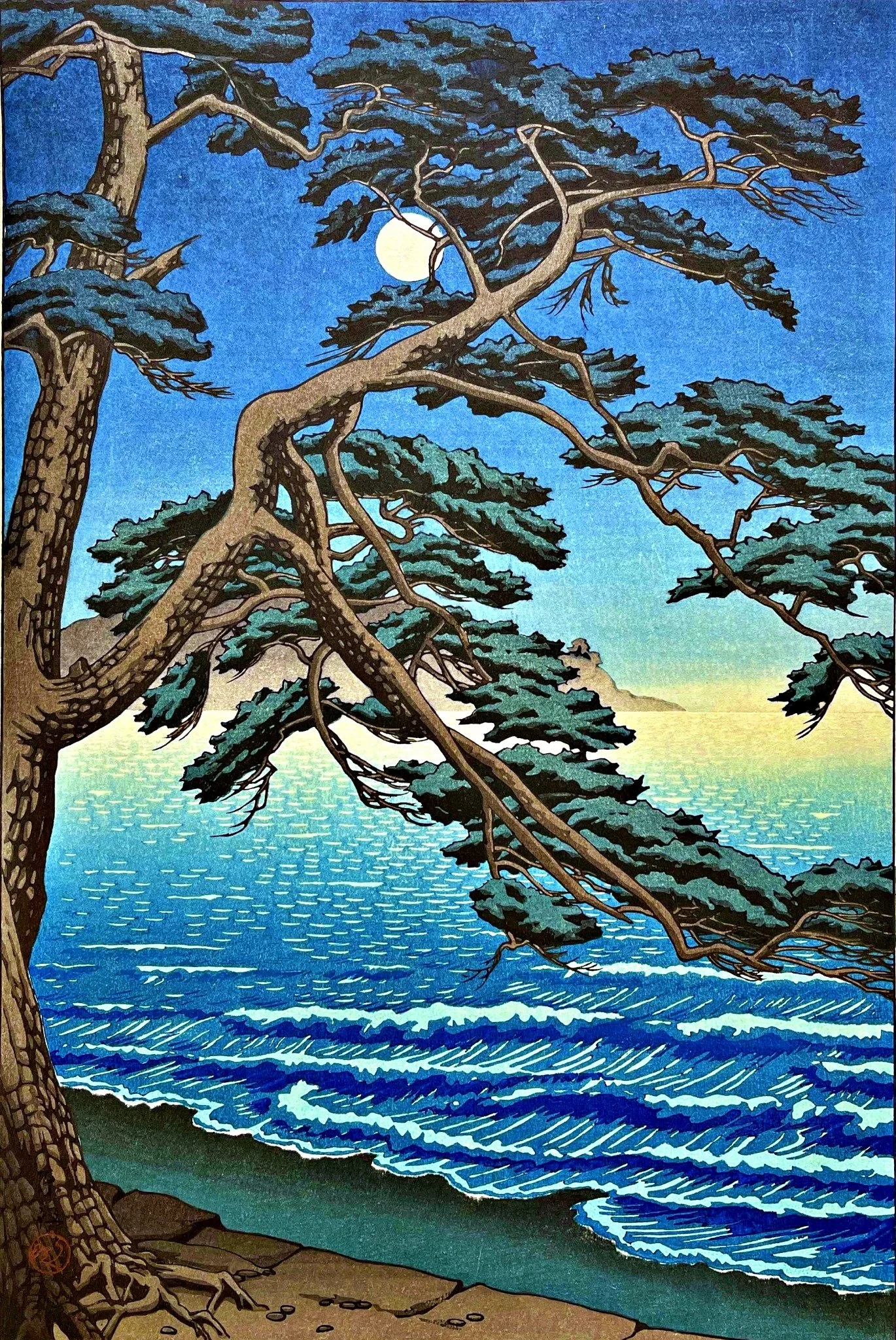
A luminous moon shines through sweeping pine branches above a sea of turquoise and deep blue. Moon at Enoshima Beach by Ishiwata Kōitsu (Tōkō) brings the open air and gentle rhythm of Japan’s coast into your home as a portrait canvas reproduction over a sturdy 1.5-inch wood stretcher.
| 16 × 24 in. | $259 CAD |
|---|---|
| 24 × 36 in. | $299 CAD |
Choose your canvas size and quantity below. All prices are in CAD.
Artwork titles and dates identify the original work. Review the product details and available options before ordering.
Ask about this print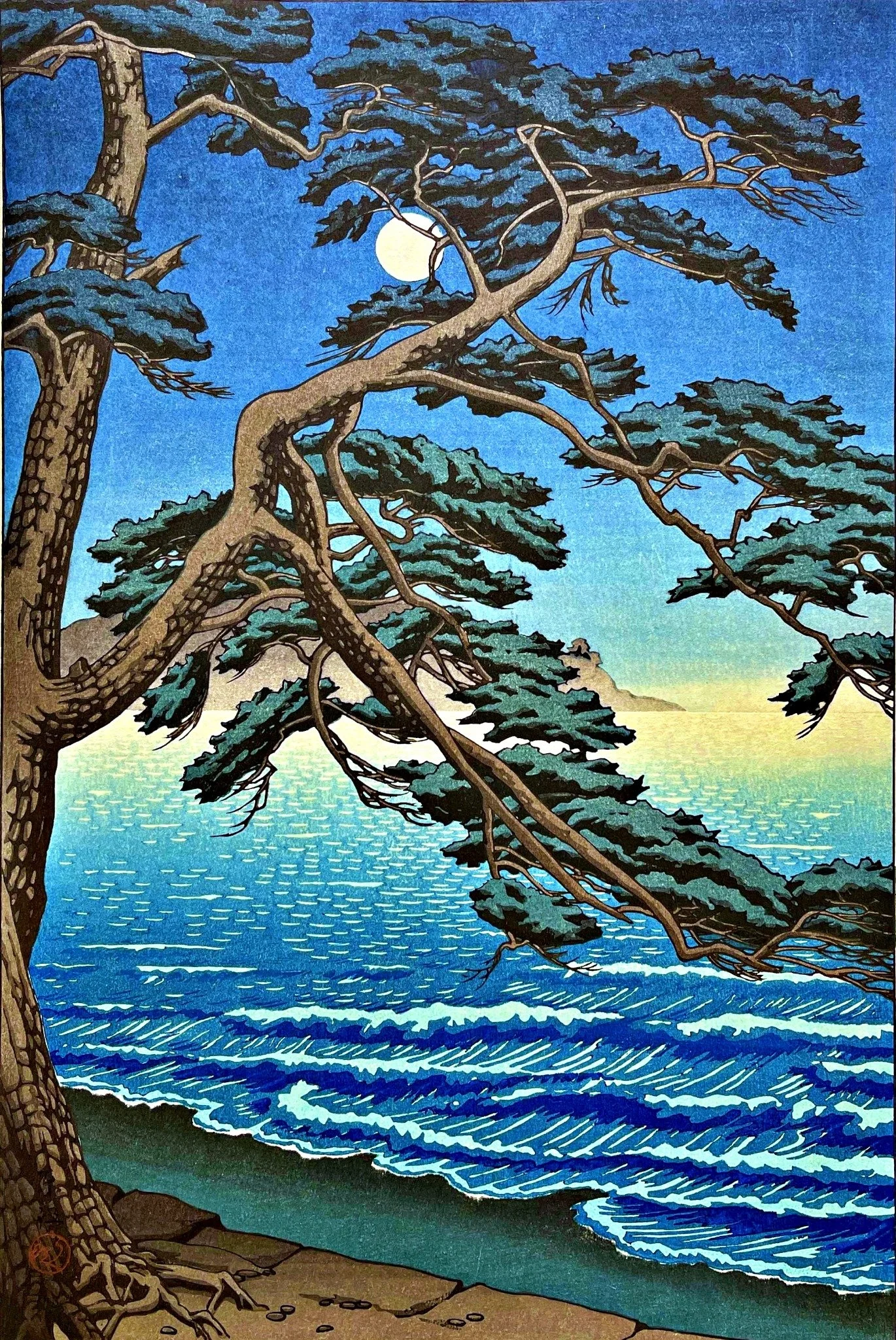
Premium quality canvas print of “Moon at Enoshima Beach” by Ishiwata Kōitsu (Tōkō)
A luminous moon shines through sweeping pine branches above a sea of turquoise and deep blue. Moon at Enoshima Beach by Ishiwata Kōitsu (Tōkō) brings the open air and gentle rhythm of Japan’s coast into your home as a portrait canvas reproduction over a sturdy 1.5-inch wood stretcher.
Product details: Canvas reproduction over a sturdy 1.5-inch wood stretcher. Available in 16 × 24 in. ($259 CAD) and 24 × 36 in. ($299 CAD). No returns accepted.
More About the Art
Moon at Enoshima Beach opens a view of the sea through the sweeping branches of a coastal pine. A bright, almost white moon hangs high in the blue sky, held within a loose frame of needles and limbs. Below it, water changes from a pale, luminous band near the horizon to saturated blue in the foreground. The image joins the quiet certainty of the moon with the repeated movement of waves arriving at the shore.
The tree is the composition’s most immediate presence. Its substantial trunk rises along the left edge, where patterned bark gives way to angular roots and scattered stones. One broad limb turns diagonally upward through the centre before dividing into smaller branches. Others reach across the middle and lower right. These intersecting lines create a sequence of openings, allowing the distant water to appear between layers of dark foliage.
The pine needles are arranged in broad, irregular clusters. Their blue-green upper surfaces stand out against nearly black undersides, while fine, bare twigs extend beyond the larger shapes. The canopy feels both weighty and open. Its layered forms bring the tree close to the viewer without completely screening the sea. A low, distant landform, partly hidden by the branches, offers a small point of orientation beyond the foreground.
Colour establishes the changing depth of the scene. The rich blue overhead becomes lighter toward the horizon, where a narrow yellow glow warms the meeting of sky and water. Across the sea, short pale marks suggest scattered light. Closer to shore, these marks lengthen and gather into energetic white crests. Bands of blue and turquoise curve beneath them, giving the waves a clear direction and a sense of continuing movement.
At the bottom, a sloping strip of sandy ground provides a resting place beneath the tree. The dark edge of the shore separates this foreground from the surf. No figures or boats interrupt the view. The empty beach allows attention to settle on the relationship between rooted pine, moving water, and the round moon. The scene feels sheltered even as the open sea extends beyond its boundaries.
The design dates to August 1933, or Shōwa 8, and was originally published by Doi Sadaichi. Its Japanese title is Tsukiyo no Enoshima, 月夜の江の嶋. The Art Institute of Chicago catalogues the work under Tōkō, identified as Ishiwata Kōitsu. Although it has circulated under Kawase Hasui’s name, the Tōkō attribution is supported by research into the artist’s names and publishing history. It should also be distinguished from work by Tsuchiya Kōitsu, a different artist.
This portrait canvas reproduction preserves the supplied image composition, from the pine’s roots and lower shore to the uppermost branches. Viewed across a room, its strong blue sea and luminous moon form a clear, inviting focal point. At closer range, the bark, interlacing twigs, broken reflections, and fine lines within the surf reward slower looking. The balance of shelter and openness gives this coastal landscape an enduring sense of release, bringing the rhythm of the shore into a quiet interior.
More About the Artist
Ishiwata Kōitsu (1897–1987), also known by the art name Tōkō, was a Japanese print designer whose career connected landscape art with textile design, commercial graphics, and experiments in printing. His work belongs to the wider history of shin-hanga, the movement that renewed Japanese woodblock printmaking in the early twentieth century. Moon at Enoshima Beach presents a particularly inviting aspect of that tradition: a familiar coastal setting transformed by moonlight, strong colour, and carefully organized natural forms.
Born in the Shiba district of Tokyo, the artist’s given name was Shōichirō. He learned textile design from his brother-in-law Igusa Senshin and also trained in Japanese-style painting, or nihonga. These early pursuits brought together drawing, pattern, colour, and the adaptation of an image to a particular surface. They provide useful context for a career in which fine art and practical design remained closely connected.
Following the Great Kantō Earthquake, he worked in the design department of the Nozawaya department store in Yokohama. This was a period when department stores were developing new visual identities and placing increasing value on professional design. He left Nozawaya in 1930 and studied with Kawase Hasui, whose atmospheric landscapes had become central to the shin-hanga movement. His transition to woodblock design grew from an established working life in the visual arts.
In 1931 and 1932, prints bearing the name Kōitsu were published by Watanabe Shōzaburō. Many depict places within the artist’s own surroundings in Yokohama, including Koyasu and the nearby waterfront. Yokohama Museum of Art has emphasized his attention to the people and activities of these neighbourhoods. Shops, temple approaches, local streets, and working spaces could carry as much significance as celebrated scenery. His landscapes preserve an interest in everyday surroundings and the way people inhabit them.
The artist used several names during his career. These include Kōitsu, Shōichirō, Yoshimi, and Tōkō, the last written 東江. Shimane Art Museum records that he published with Doi under the Tōkō name in 1933 and with Katō under Shōichirō in the middle of the decade. Recognizing these names helps connect works that were once discussed separately. The Enoshima design is catalogued by the Art Institute of Chicago as a work by Tōkō, identified there as Ishiwata Kōitsu.
Shin-hanga production generally involved collaboration among designer, publisher, carver, and printer. The designer established the image, while specialist skills translated its lines and colour areas into a finished impression. In Moon at Enoshima Beach, the substantial pine, delicate twigs, open sky, and finely broken surf show how varied those demands could be within one composition. The clarity of the scene depends on the relationship between its large shapes and its smallest marks.
His interests extended beyond conventional woodblock production. Research based on materials donated to Yokohama Museum of Art documents experiments with stencil printing, later screenprinting, and commercial design. During the 1930s he also produced images of toys and landscapes for Katō. His subsequent work included designs for printed products and involvement with printing technology. This broader record reveals an adaptable artist who continued to explore how images could be made and circulated across different settings.
Moon at Enoshima Beach invites attention to that combination of observation and design. The pine’s irregular branches are firmly organized, while the sea’s repeated white lines remain lively. A pale moon and a warm horizon keep the many blue tones from becoming uniform. The image offers an encounter with coastal space that feels immediate and carefully composed, carrying the eye from the rooted tree toward the distant, luminous water.
Sources for the artwork and artist
Shimane Art Museum — Ishiwata Kōitsu biography; names, training and 1933 Doi publication under Tōkō
Yokohama Museum of Art — Kōitsu and his era; Nozawaya, Hasui, Watanabe and collaborative printmaking
Marc Kahn, Shotei.com — Tōkō; comparative signature research and documentary evidence linking the name to Ishiwata Kōitsu
Premium quality canvas print of “Moon at Enoshima Beach” by Ishiwata Kōitsu (Tōkō)
A luminous moon shines through sweeping pine branches above a sea of turquoise and deep blue. Moon at Enoshima Beach by Ishiwata Kōitsu (Tōkō) brings the open air and gentle rhythm of Japan’s coast into your home as a portrait canvas reproduction over a sturdy 1.5-inch wood stretcher.
Product details: Canvas reproduction over a sturdy 1.5-inch wood stretcher. Available in 16 × 24 in. ($259 CAD) and 24 × 36 in. ($299 CAD). No returns accepted.
More About the Art
Moon at Enoshima Beach opens a view of the sea through the sweeping branches of a coastal pine. A bright, almost white moon hangs high in the blue sky, held within a loose frame of needles and limbs. Below it, water changes from a pale, luminous band near the horizon to saturated blue in the foreground. The image joins the quiet certainty of the moon with the repeated movement of waves arriving at the shore.
The tree is the composition’s most immediate presence. Its substantial trunk rises along the left edge, where patterned bark gives way to angular roots and scattered stones. One broad limb turns diagonally upward through the centre before dividing into smaller branches. Others reach across the middle and lower right. These intersecting lines create a sequence of openings, allowing the distant water to appear between layers of dark foliage.
The pine needles are arranged in broad, irregular clusters. Their blue-green upper surfaces stand out against nearly black undersides, while fine, bare twigs extend beyond the larger shapes. The canopy feels both weighty and open. Its layered forms bring the tree close to the viewer without completely screening the sea. A low, distant landform, partly hidden by the branches, offers a small point of orientation beyond the foreground.
Colour establishes the changing depth of the scene. The rich blue overhead becomes lighter toward the horizon, where a narrow yellow glow warms the meeting of sky and water. Across the sea, short pale marks suggest scattered light. Closer to shore, these marks lengthen and gather into energetic white crests. Bands of blue and turquoise curve beneath them, giving the waves a clear direction and a sense of continuing movement.
At the bottom, a sloping strip of sandy ground provides a resting place beneath the tree. The dark edge of the shore separates this foreground from the surf. No figures or boats interrupt the view. The empty beach allows attention to settle on the relationship between rooted pine, moving water, and the round moon. The scene feels sheltered even as the open sea extends beyond its boundaries.
The design dates to August 1933, or Shōwa 8, and was originally published by Doi Sadaichi. Its Japanese title is Tsukiyo no Enoshima, 月夜の江の嶋. The Art Institute of Chicago catalogues the work under Tōkō, identified as Ishiwata Kōitsu. Although it has circulated under Kawase Hasui’s name, the Tōkō attribution is supported by research into the artist’s names and publishing history. It should also be distinguished from work by Tsuchiya Kōitsu, a different artist.
This portrait canvas reproduction preserves the supplied image composition, from the pine’s roots and lower shore to the uppermost branches. Viewed across a room, its strong blue sea and luminous moon form a clear, inviting focal point. At closer range, the bark, interlacing twigs, broken reflections, and fine lines within the surf reward slower looking. The balance of shelter and openness gives this coastal landscape an enduring sense of release, bringing the rhythm of the shore into a quiet interior.
More About the Artist
Ishiwata Kōitsu (1897–1987), also known by the art name Tōkō, was a Japanese print designer whose career connected landscape art with textile design, commercial graphics, and experiments in printing. His work belongs to the wider history of shin-hanga, the movement that renewed Japanese woodblock printmaking in the early twentieth century. Moon at Enoshima Beach presents a particularly inviting aspect of that tradition: a familiar coastal setting transformed by moonlight, strong colour, and carefully organized natural forms.
Born in the Shiba district of Tokyo, the artist’s given name was Shōichirō. He learned textile design from his brother-in-law Igusa Senshin and also trained in Japanese-style painting, or nihonga. These early pursuits brought together drawing, pattern, colour, and the adaptation of an image to a particular surface. They provide useful context for a career in which fine art and practical design remained closely connected.
Following the Great Kantō Earthquake, he worked in the design department of the Nozawaya department store in Yokohama. This was a period when department stores were developing new visual identities and placing increasing value on professional design. He left Nozawaya in 1930 and studied with Kawase Hasui, whose atmospheric landscapes had become central to the shin-hanga movement. His transition to woodblock design grew from an established working life in the visual arts.
In 1931 and 1932, prints bearing the name Kōitsu were published by Watanabe Shōzaburō. Many depict places within the artist’s own surroundings in Yokohama, including Koyasu and the nearby waterfront. Yokohama Museum of Art has emphasized his attention to the people and activities of these neighbourhoods. Shops, temple approaches, local streets, and working spaces could carry as much significance as celebrated scenery. His landscapes preserve an interest in everyday surroundings and the way people inhabit them.
The artist used several names during his career. These include Kōitsu, Shōichirō, Yoshimi, and Tōkō, the last written 東江. Shimane Art Museum records that he published with Doi under the Tōkō name in 1933 and with Katō under Shōichirō in the middle of the decade. Recognizing these names helps connect works that were once discussed separately. The Enoshima design is catalogued by the Art Institute of Chicago as a work by Tōkō, identified there as Ishiwata Kōitsu.
Shin-hanga production generally involved collaboration among designer, publisher, carver, and printer. The designer established the image, while specialist skills translated its lines and colour areas into a finished impression. In Moon at Enoshima Beach, the substantial pine, delicate twigs, open sky, and finely broken surf show how varied those demands could be within one composition. The clarity of the scene depends on the relationship between its large shapes and its smallest marks.
His interests extended beyond conventional woodblock production. Research based on materials donated to Yokohama Museum of Art documents experiments with stencil printing, later screenprinting, and commercial design. During the 1930s he also produced images of toys and landscapes for Katō. His subsequent work included designs for printed products and involvement with printing technology. This broader record reveals an adaptable artist who continued to explore how images could be made and circulated across different settings.
Moon at Enoshima Beach invites attention to that combination of observation and design. The pine’s irregular branches are firmly organized, while the sea’s repeated white lines remain lively. A pale moon and a warm horizon keep the many blue tones from becoming uniform. The image offers an encounter with coastal space that feels immediate and carefully composed, carrying the eye from the rooted tree toward the distant, luminous water.
Sources for the artwork and artist
- Art Institute of Chicago — Moon at Enoshima Beach (Tsukiyo no Enoshima); Tōkō (Ishiwata Kōitsu), 1933
- Shimane Art Museum — Ishiwata Kōitsu biography; names, training and 1933 Doi publication under Tōkō
- Art Platform Japan, Dictionary of Artists in Japan — Ishiwata Kōitsu; dates and art names including 東江
- Yokohama Museum of Art — Kōitsu and his era; Nozawaya, Hasui, Watanabe and collaborative printmaking
- Yuko Katada, Yokohama Museum of Art Bulletin No. 16 (2015) — Research based on newly acquired works and documentation; pp. 5–16 and English summary p. 57
- Marc Kahn, Shotei.com — Tōkō; comparative signature research and documentary evidence linking the name to Ishiwata Kōitsu
- Kawase Hasui Catalogue — Moon at Enoshima Beach; Doi Sadaichi, 1933, and correction of the Hasui attribution
- Japanese Art Open Database — Moon at Enoshima Beach; Japanese title, August 1933 design date and Doi Sadaichi