
Japanese art on canvas
Matsushima, Futagojima (Boat Detail)
Kawase Hasui · 1933
From $259 CAD
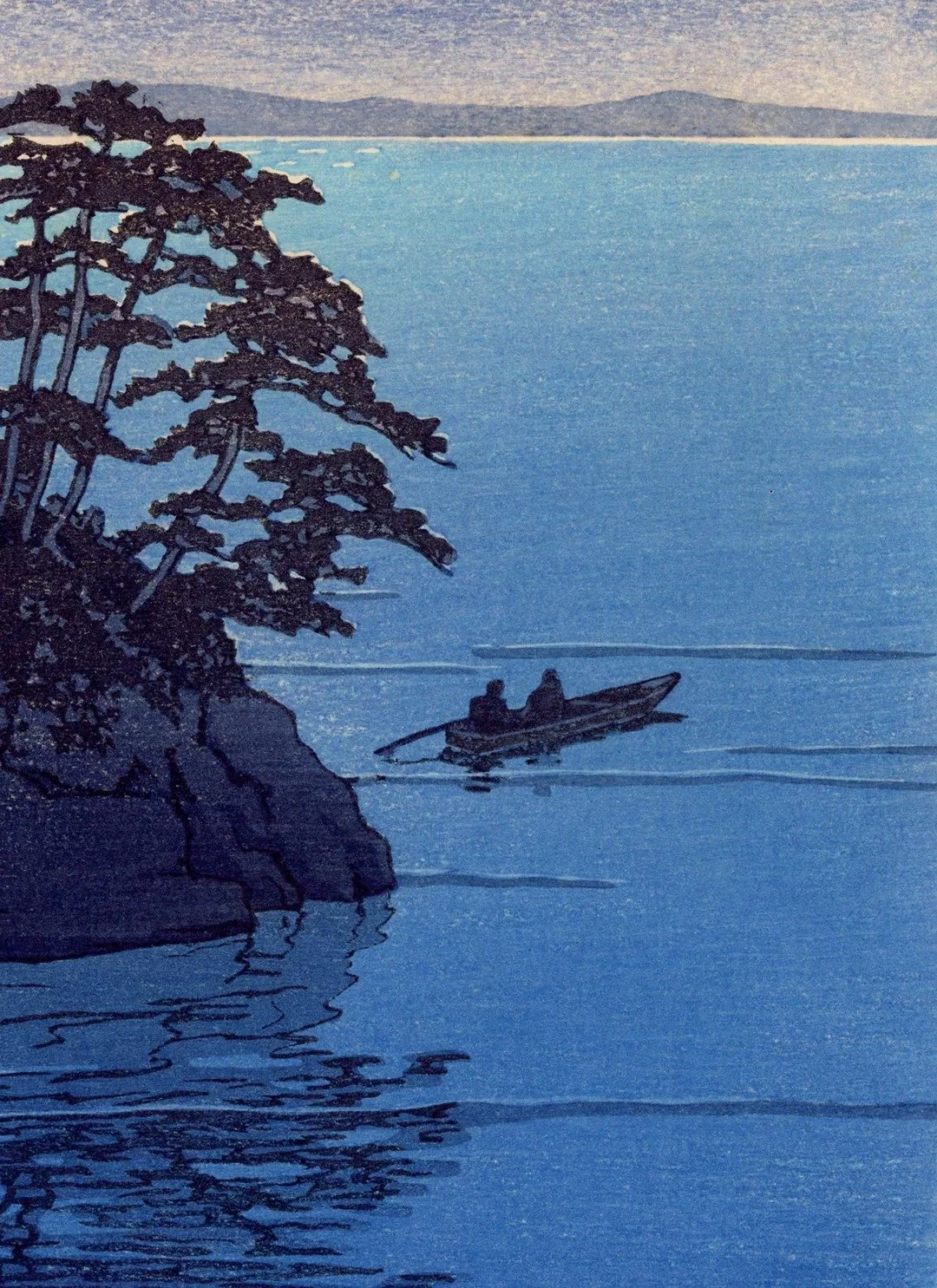
A pine-covered island and a small boat rest within an expanse of blue water. This selected detail from Kawase Hasui’s Matsushima, Futagojima brings the quiet intimacy of Japan’s celebrated coastal landscape into your home as a cropped canvas reproduction over a sturdy 1.5-inch wood stretcher.
| 16 × 24 in. | $259 CAD |
|---|---|
| 24 × 36 in. | $299 CAD |
Choose your canvas size and quantity below. All prices are in CAD.
Artwork titles and dates identify the original work. Review the product details and available options before ordering.
Ask about this print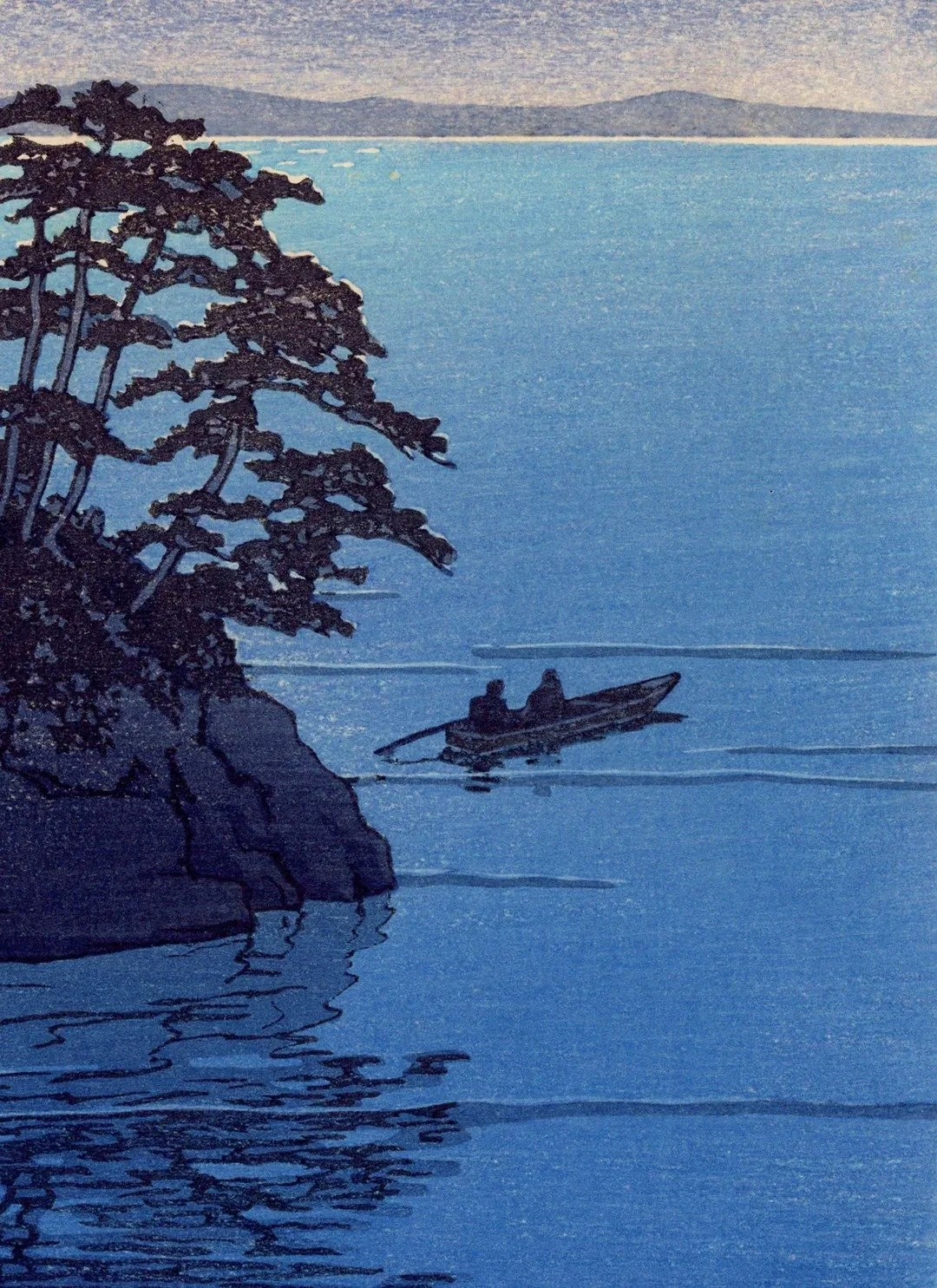
Premium quality canvas print of “Matsushima, Futagojima (Boat Detail)” by Kawase Hasui
A pine-covered island and a small boat rest within an expanse of blue water. This selected detail from Kawase Hasui’s Matsushima, Futagojima brings the quiet intimacy of Japan’s celebrated coastal landscape into your home as a cropped canvas reproduction over a sturdy 1.5-inch wood stretcher.
Product details: Cropped canvas reproduction of a selected detail from the original design, over a sturdy 1.5-inch wood stretcher. “Boat Detail” is a descriptive label for this crop. Available in 16 × 24 in. ($259 CAD) and 24 × 36 in. ($299 CAD). No returns accepted.
More About the Art
Matsushima, Futagojima (Boat Detail) presents a selected portion of Kawase Hasui’s 1933 woodblock design, concentrating on a pine-covered rocky island, a small boat, and the blue water around them. The portrait crop draws attention to the meeting of solid land and open sea. Dark trees rise along the left edge, their irregular branches extending above the water. Farther out, two figures sit in a narrow boat, with a distant shore stretching across the upper view.
The island gives this detail its strongest structure. Its steep rock face descends into the water in broad, uneven forms. Above it, pine trunks divide into long branches, carrying dense clusters of needles. Gaps within the foliage reveal the blue behind them. Pale edges along some branches keep their shapes distinct against the water. The trees create a varied silhouette, while the rock beneath supplies weight and stability. Together they make the nearby island feel substantial within the spaciousness of the bay.
The boat introduces a different scale. Its dark hull sits low in the water, and an oar projects outward beside the two small figures. Their identities and destination remain unspecified. What matters visually is the simple relationship between the people, their narrow vessel, and the island nearby. The human presence makes the scene approachable, allowing the broad blue water to become somewhere experienced from a boat as well as seen from a distance.
Reflections connect the island with its surroundings. The dark shapes beneath the rock and pines break into wavering lines, becoming more widely spaced toward the foreground. Longer horizontal marks cross the open water near the boat. These small changes suggest movement without disturbing the overall calm. Blue remains the dominant colour, varying from pale passages near the distance to deeper tones below the island and along the lower edge.
The distant shore creates a quiet boundary at the top of the selected view. Its low hills form a continuous band beyond the brighter water. A narrow stretch of textured sky completes this sense of distance. The portrait presentation brings these elements into a close relationship: nearby pines, rock, boat, reflections, and far shore. Each becomes part of a compact coastal scene that rewards slow attention.
Hasui designed the complete print in December 1933, and Watanabe Shōzaburō published it within Collected Views of Japan, Eastern Japan Edition. Its Japanese title is Matsushima Futagojima, written 松嶋双子嶋. The original horizontal composition includes a full moon above the bay; this canvas reproduces the selected detail shown here, focused on the island, boat, and water. Museum catalogues also call the complete work Futago Island: Moonlight at Matsushima.
Matsushima Bay lies in Miyagi Prefecture and is celebrated for its pine-covered islets, traditionally counted among Japan’s Three Scenic Views. This cropped reproduction offers an intimate encounter with that landscape through the details preserved in Hasui’s design. Mounted on canvas, its blues create a calm colour presence, while the dark pine and boat provide clear forms to discover at closer range. It brings the quiet space beside an island into a contemporary room.
More About the Artist
Kawase Hasui (1883–1957) was a Japanese artist whose colour woodblock landscapes bring together a clear sense of place and a sensitive response to atmosphere. His subjects include temple grounds, city waterways, country roads, mountain settlements, and coastal views. Across this variety, he paid particular attention to the way light and weather change familiar forms. His complete Matsushima, Futagojima design of 1933 belongs to this sustained exploration of Japan’s landscapes through the woodblock medium.
Hasui was born in Tokyo with the given name Bunjiro. His artistic education included Western-style painting under Okada Saburosuke and Japanese-style painting with Kaburaki Kiyokata, whose studio he joined in 1910. Kiyokata gave him his artist’s name. These different strands of training helped him combine strong outlines and carefully arranged forms with an interest in distance, tonal change, and the observed character of a setting.
The landscape prints of Itō Shinsui, another artist in Kiyokata’s circle, encouraged his interest in woodblock design. In 1918, Hasui began collaborating with the publisher Watanabe Shōzaburō. Their long association became central to shin-hanga, or “new prints,” the twentieth-century renewal of Japanese woodblock production. Artists, specialist carvers, printers, and publishers worked together, continuing a shared craft tradition while developing new approaches to colour, composition, and atmospheric effects.
A finished print therefore depended on the coordination of several kinds of expertise. A drawing had to be interpreted through carved blocks, and successive colours needed to form a coherent image. A delicate pine branch and a broad expanse of water called for different treatments. In the Matsushima design, dense foliage, solid rock, small figures, and changing reflections remain distinct while contributing to the same coastal atmosphere. Such relationships are part of the pleasure of looking closely at his work.
Travel and sketching supplied Hasui with a continuing store of subjects. He journeyed widely across Japan, recording views that later became woodblock designs. Matsushima offered an especially rich landscape of pines, islands, water, and distant shores. The 1933 print forms part of Collected Views of Japan, Eastern Japan Edition, connecting this bay with a wider body of regional scenes. Museum collections preserve the complete design within that series, making its original format and context available for study.
His career also involved major losses. The Great Kantō Earthquake of 1923 destroyed Watanabe’s premises, woodblocks, and print stock, while Hasui lost his house and sketchbooks. He continued travelling and designing afterward. Through the later 1920s and following decades, his landscapes explored a broad range of seasons and conditions. The productive years of the early 1930s included many works in which water, architecture, and trees became closely connected through light and carefully chosen viewpoints.
Hasui continued working after the Second World War and remained active into the 1950s. In 1953, the production of Snow at Zōjōji Temple was documented by Japan’s Cultural Properties Protection Committee, preserving a record of the collaborative craft behind a finished print. His career ultimately encompassed more than six hundred designs. Museum collections now allow this extensive body of work to be appreciated in both its individual settings and its recurring visual interests.
The selected detail offered here encourages attention to a few of those interests: the patterned edge of a pine, the meeting of rock and water, the scale of a small boat, and the changing shape of a reflection. These elements belong to Hasui’s complete composition, while the crop gives them a more intimate presentation. Their clarity and quiet relationships help explain why his landscapes continue to invite repeated, unhurried looking.
Sources
LACMA — Futago Island: Moonlight at Matsushima; complete horizontal woodblock print, 1933
Kawase Hasui Catalogue — Futago Islands, Matsushima; title, series and publication details
Egenolf Gallery — Matsushima, Futagojima; complete composition and publication record
Miyagi Prefectural Government / Visit Miyagi — Matsushima Bay and its pine-covered islands
Japan National Tourism Organization — Matsushima and Japan’s Three Scenic Views
Japan Museum SieboldHuis — Kawase Hasui: Capturing the Soul of Japan
Tokyo Fuji Art Museum — Kawase Hasui biography and 1953 print-production documentation
Premium quality canvas print of “Matsushima, Futagojima (Boat Detail)” by Kawase Hasui
A pine-covered island and a small boat rest within an expanse of blue water. This selected detail from Kawase Hasui’s Matsushima, Futagojima brings the quiet intimacy of Japan’s celebrated coastal landscape into your home as a cropped canvas reproduction over a sturdy 1.5-inch wood stretcher.
Product details: Cropped canvas reproduction of a selected detail from the original design, over a sturdy 1.5-inch wood stretcher. “Boat Detail” is a descriptive label for this crop. Available in 16 × 24 in. ($259 CAD) and 24 × 36 in. ($299 CAD). No returns accepted.
More About the Art
Matsushima, Futagojima (Boat Detail) presents a selected portion of Kawase Hasui’s 1933 woodblock design, concentrating on a pine-covered rocky island, a small boat, and the blue water around them. The portrait crop draws attention to the meeting of solid land and open sea. Dark trees rise along the left edge, their irregular branches extending above the water. Farther out, two figures sit in a narrow boat, with a distant shore stretching across the upper view.
The island gives this detail its strongest structure. Its steep rock face descends into the water in broad, uneven forms. Above it, pine trunks divide into long branches, carrying dense clusters of needles. Gaps within the foliage reveal the blue behind them. Pale edges along some branches keep their shapes distinct against the water. The trees create a varied silhouette, while the rock beneath supplies weight and stability. Together they make the nearby island feel substantial within the spaciousness of the bay.
The boat introduces a different scale. Its dark hull sits low in the water, and an oar projects outward beside the two small figures. Their identities and destination remain unspecified. What matters visually is the simple relationship between the people, their narrow vessel, and the island nearby. The human presence makes the scene approachable, allowing the broad blue water to become somewhere experienced from a boat as well as seen from a distance.
Reflections connect the island with its surroundings. The dark shapes beneath the rock and pines break into wavering lines, becoming more widely spaced toward the foreground. Longer horizontal marks cross the open water near the boat. These small changes suggest movement without disturbing the overall calm. Blue remains the dominant colour, varying from pale passages near the distance to deeper tones below the island and along the lower edge.
The distant shore creates a quiet boundary at the top of the selected view. Its low hills form a continuous band beyond the brighter water. A narrow stretch of textured sky completes this sense of distance. The portrait presentation brings these elements into a close relationship: nearby pines, rock, boat, reflections, and far shore. Each becomes part of a compact coastal scene that rewards slow attention.
Hasui designed the complete print in December 1933, and Watanabe Shōzaburō published it within Collected Views of Japan, Eastern Japan Edition. Its Japanese title is Matsushima Futagojima, written 松嶋双子嶋. The original horizontal composition includes a full moon above the bay; this canvas reproduces the selected detail shown here, focused on the island, boat, and water. Museum catalogues also call the complete work Futago Island: Moonlight at Matsushima.
Matsushima Bay lies in Miyagi Prefecture and is celebrated for its pine-covered islets, traditionally counted among Japan’s Three Scenic Views. This cropped reproduction offers an intimate encounter with that landscape through the details preserved in Hasui’s design. Mounted on canvas, its blues create a calm colour presence, while the dark pine and boat provide clear forms to discover at closer range. It brings the quiet space beside an island into a contemporary room.
More About the Artist
Kawase Hasui (1883–1957) was a Japanese artist whose colour woodblock landscapes bring together a clear sense of place and a sensitive response to atmosphere. His subjects include temple grounds, city waterways, country roads, mountain settlements, and coastal views. Across this variety, he paid particular attention to the way light and weather change familiar forms. His complete Matsushima, Futagojima design of 1933 belongs to this sustained exploration of Japan’s landscapes through the woodblock medium.
Hasui was born in Tokyo with the given name Bunjiro. His artistic education included Western-style painting under Okada Saburosuke and Japanese-style painting with Kaburaki Kiyokata, whose studio he joined in 1910. Kiyokata gave him his artist’s name. These different strands of training helped him combine strong outlines and carefully arranged forms with an interest in distance, tonal change, and the observed character of a setting.
The landscape prints of Itō Shinsui, another artist in Kiyokata’s circle, encouraged his interest in woodblock design. In 1918, Hasui began collaborating with the publisher Watanabe Shōzaburō. Their long association became central to shin-hanga, or “new prints,” the twentieth-century renewal of Japanese woodblock production. Artists, specialist carvers, printers, and publishers worked together, continuing a shared craft tradition while developing new approaches to colour, composition, and atmospheric effects.
A finished print therefore depended on the coordination of several kinds of expertise. A drawing had to be interpreted through carved blocks, and successive colours needed to form a coherent image. A delicate pine branch and a broad expanse of water called for different treatments. In the Matsushima design, dense foliage, solid rock, small figures, and changing reflections remain distinct while contributing to the same coastal atmosphere. Such relationships are part of the pleasure of looking closely at his work.
Travel and sketching supplied Hasui with a continuing store of subjects. He journeyed widely across Japan, recording views that later became woodblock designs. Matsushima offered an especially rich landscape of pines, islands, water, and distant shores. The 1933 print forms part of Collected Views of Japan, Eastern Japan Edition, connecting this bay with a wider body of regional scenes. Museum collections preserve the complete design within that series, making its original format and context available for study.
His career also involved major losses. The Great Kantō Earthquake of 1923 destroyed Watanabe’s premises, woodblocks, and print stock, while Hasui lost his house and sketchbooks. He continued travelling and designing afterward. Through the later 1920s and following decades, his landscapes explored a broad range of seasons and conditions. The productive years of the early 1930s included many works in which water, architecture, and trees became closely connected through light and carefully chosen viewpoints.
Hasui continued working after the Second World War and remained active into the 1950s. In 1953, the production of Snow at Zōjōji Temple was documented by Japan’s Cultural Properties Protection Committee, preserving a record of the collaborative craft behind a finished print. His career ultimately encompassed more than six hundred designs. Museum collections now allow this extensive body of work to be appreciated in both its individual settings and its recurring visual interests.
The selected detail offered here encourages attention to a few of those interests: the patterned edge of a pine, the meeting of rock and water, the scale of a small boat, and the changing shape of a reflection. These elements belong to Hasui’s complete composition, while the crop gives them a more intimate presentation. Their clarity and quiet relationships help explain why his landscapes continue to invite repeated, unhurried looking.
Sources for the artwork and artist
- Smithsonian National Museum of Asian Art — Complete Futago Island, Matsushima design; December 1933, Watanabe publisher and Eastern Japan series
- LACMA — Futago Island: Moonlight at Matsushima; complete horizontal woodblock print, 1933
- National Museum of Modern Art, Tokyo — Futago Island, Matsushima; Japanese title and Eastern Japan series
- Kawase Hasui Catalogue — Futago Islands, Matsushima; title, series and publication details
- Egenolf Gallery — Matsushima, Futagojima; complete composition and publication record
- Miyagi Prefectural Government / Visit Miyagi — Matsushima Bay and its pine-covered islands
- Japan National Tourism Organization — Matsushima and Japan’s Three Scenic Views
- British Museum — Kawase Hasui biography
- Japan Museum SieboldHuis — Kawase Hasui: Capturing the Soul of Japan
- Tokyo Fuji Art Museum — Kawase Hasui biography and 1953 print-production documentation