
Japanese art on canvas
Maiko Beach
Tsuchiya Koitsu · 1936
From $259 CAD
A canvas reproduction of Maiko Beach, presented on a 1.5-inch wood stretcher.
| 16 × 24 in. | $259 CAD |
|---|---|
| 24 × 36 in. | $299 CAD |
Choose your canvas size and quantity below. All prices are in CAD.
Artwork titles and dates identify the original work. Review the product details and available options before ordering.
Ask about this printPremium quality canvas print of Tsuchiya Koitsu’s “Maiko Beach”
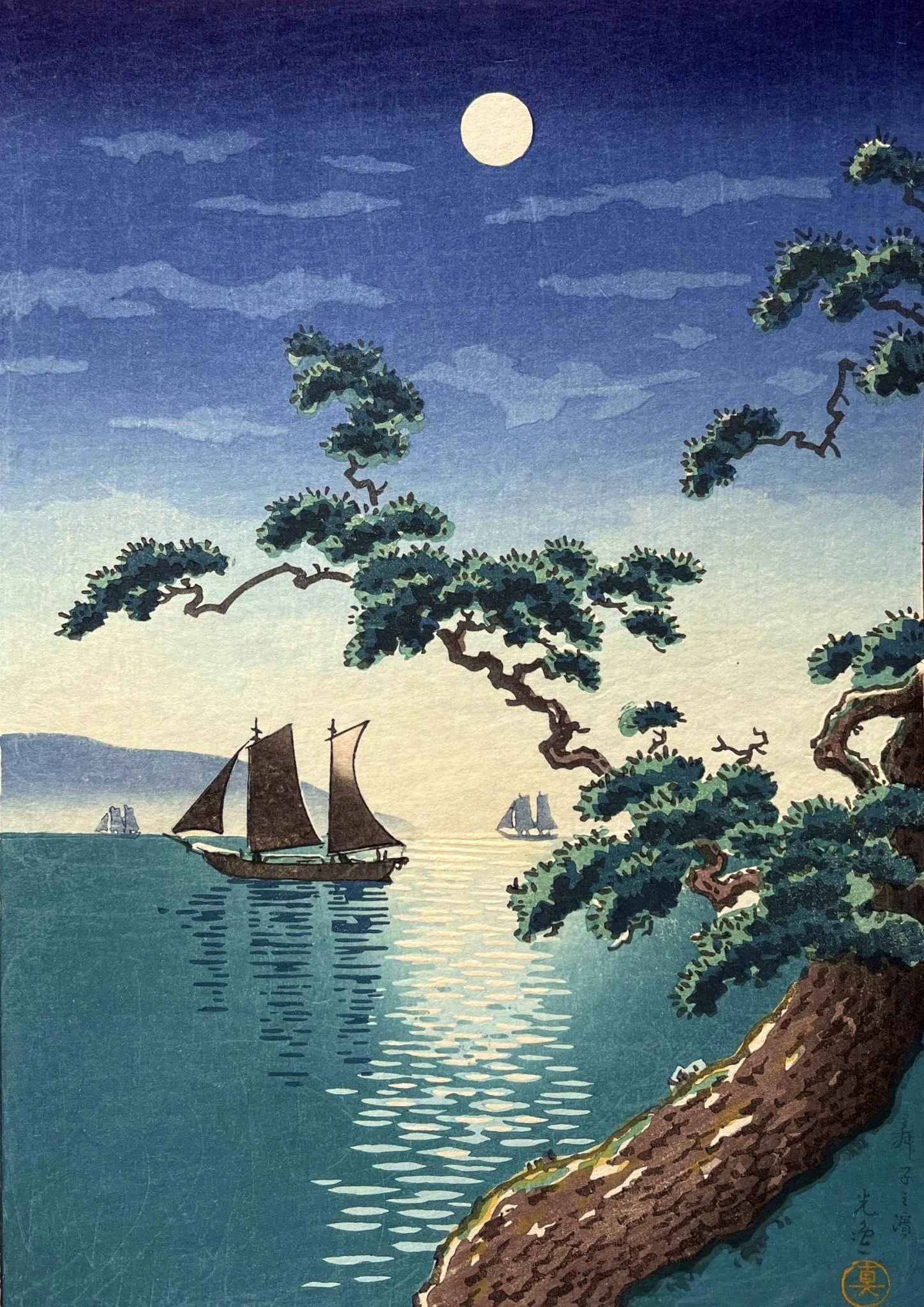
Let moonlight open a quiet view across your room. Tsuchiya Koitsu’s Maiko Beach brings a leaning pine, distant sails and a shimmering sea into a richly coloured night scene. Reproduced on canvas over a sturdy 1.5-inch wood stretcher, its deep blues and pale reflections offer a calm focal point with a strong sense of space.
Product details: Canvas reproduction over a sturdy 1.5-inch wood stretcher. Available in 16 × 24 in. ($259 CAD) and 24 × 36 in. ($299 CAD). No returns accepted.
More About the Art
Maiko Beach brings the viewer close to a pine tree and then carries the eye far out across the water. A thick trunk rises diagonally from the lower foreground toward the right edge, while a long branch reaches back across the picture. Beyond this sheltering frame, sailing boats move through an open expanse of blue-green sea. The composition balances the tree’s substantial presence with the spaciousness of sky and water.
The pine has a distinctive physical character. Brown, grey and dark angular marks describe its rough bark, with paler edges making parts of the trunk stand out against the sea. Smaller branches change direction abruptly before disappearing into clusters of foliage. The needles gather in rounded, irregular masses of deep green and blue, giving the tree both a strong silhouette and a richly varied surface.
One sailing boat occupies the middle distance, its dark hull and raised sails clearly outlined against the brighter horizon. Broken horizontal marks carry its reflection into the water below. Two smaller vessels appear farther away, their lighter forms suggesting distance. A low blue landform recedes behind them on the left, adding another layer between the close pine and the broad reach of the sea.
Above the boats, a full moon sits in a generous field of blue. Its warm, pale circle is simple and sharply defined, surrounded by thin, scattered clouds. The sky deepens toward the top and becomes much lighter near the horizon. This gradual change gives the lower atmosphere a soft glow, allowing the silhouetted sails and dark pine needles to remain distinct without making the scene feel harsh.
The moon’s reflection is the brightest movement in the picture. Small cream and gold marks form a broken path across the water, widening and separating as they approach the foreground. Their horizontal rhythm suggests the slight movement of the surface. Together, the moon and its reflection establish a luminous vertical connection, set against the diagonal trunk and the outward reach of the pine’s branches.
Maiko is a coastal setting in Kobe with a long association with pine trees and pale sand. The official history of Maiko Park describes the shore as a place celebrated in poetry and enjoyed by travellers over the years. Koitsu’s view centres on the relationship between pine and sea, offering a close, atmospheric encounter with features that have long shaped the identity of this landscape.
The Kanagawa Prefectural Museum of Cultural History records Koitsu’s Maiko no Hama, or Maiko Beach, as a 1936 woodblock design in its exhibition checklist. This canvas reproduction presents the historical composition in a contemporary format. Its appeal remains closely connected to the arrangement of light and dark: the pine provides texture and weight, while the open sky and pale water carry the view into distance.
In a living space or study, the image offers a quiet centre of attention without losing visual strength. From farther away, the broad pine and bright reflection establish the scene. Closer viewing reveals bark patterns, small vessels, cloud shapes and the broken edges of reflected light. The picture holds these different scales together, inviting the eye to move from a nearby branch to the distant horizon and back again.
More About the Artist
Tsuchiya Koitsu (1870–1949) came to his mature landscape prints through a long apprenticeship and a career that extended across several periods of Japanese art. Born into a farming family in Hamamatsu, Shizuoka, he became a pupil of Kobayashi Kiyochika at sixteen. He lived with his teacher for nearly twenty years, and received the artist name Koitsu from him. This sustained connection placed him within an established tradition of woodblock design.
Kiyochika’s landscape prints explored fresh ways of representing space through perspective and shading. In its exhibition on Kiyochika, Inoue Yasuji and Koitsu, Chigasaki City Museum of Art describes Koitsu as continuing his teacher’s approach and becoming particularly accomplished in night views. That relationship provides a useful way into his art: buildings, trees and water can become expressive through the light surrounding them, as well as through their outlines.
Koitsu’s activity as a shin-hanga artist developed when he was already in his sixties. The term means “new prints” and describes a renewal of woodblock art that brought contemporary designs into an established method of production. His contribution therefore grew from experience acquired over decades. The mature prints bring an older artistic training into the visual world of the early twentieth century.
That method depended on collaboration. The artist supplied a design, specialist carvers translated it into woodblocks, and printers brought the image into colour under a publisher’s direction. The Metropolitan Museum of Art explains how separate blocks carried different colours, with guides allowing successive impressions to align. Within this shared process, a landscape could combine precise architectural detail with broader areas of colour. The finished historical print embodied the work of several skilled participants.
Doi was central to Koitsu’s landscape production. The company traces its beginnings to a shop opened by Doi Sadaichi in Tokyo in 1924, and records publishing approximately eighty Koitsu prints between 1933 and 1944. That sustained activity places the publisher within the story of his mature career. It also gives a sense of the continuing practical relationships through which an artist’s designs reached viewers as finished woodblock prints.
His subjects also included the city at quieter hours. Chigasaki’s 2014 exhibition presented the complete twelve prints of his Tokyo Views alongside works by Kiyochika and Yasuji. This curatorial grouping draws attention to a continuing exploration of landscape across generations. Koitsu’s interest in atmosphere connects places with the conditions in which they are seen: the same familiar architecture can feel sheltered, distant or newly revealed as light and weather change.
Water and travel scenery formed another part of his range. The Tokaido Hiroshige Museum of Art included Returning Sailboat at Yabase, from Eight Views of Ōmi, in its survey of landscape printmaking. Together with his urban subjects, such a work shows the breadth of settings available to him. The artist’s landscape practice extended beyond a single city view or architectural motif.
Koitsu’s work also has an enduring place in the public collection of Chigasaki City Museum of Art, where he is identified among the artists central to its holdings. That recognition supports viewing his prints as part of a wider artistic history, while their visual qualities remain immediately approachable. In Maiko Beach, the pine, dark sails and bright water create relationships that can be enjoyed before any historical detail is known.
Looking closely at this seascape, the eye moves between weight and lightness. The trunk seems substantial and close, while the smaller vessels are almost absorbed into the distance. Moonlight joins the two through a broken path on the water. This interplay offers a direct way to appreciate Koitsu’s treatment of atmosphere: a few recognizable elements become a whole setting, made expressive through their scale, colour and placement.
Sources
Premium quality canvas print of Tsuchiya Koitsu’s “Maiko Beach”
Let moonlight open a quiet view across your room. Tsuchiya Koitsu’s Maiko Beach brings a leaning pine, distant sails and a shimmering sea into a richly coloured night scene. Reproduced on canvas over a sturdy 1.5-inch wood stretcher, its deep blues and pale reflections offer a calm focal point with a strong sense of space.
Product details: Canvas reproduction over a sturdy 1.5-inch wood stretcher. Available in 16 × 24 in. ($259 CAD) and 24 × 36 in. ($299 CAD). No returns accepted.
More About the Art
Maiko Beach brings the viewer close to a pine tree and then carries the eye far out across the water. A thick trunk rises diagonally from the lower foreground toward the right edge, while a long branch reaches back across the picture. Beyond this sheltering frame, sailing boats move through an open expanse of blue-green sea. The composition balances the tree’s substantial presence with the spaciousness of sky and water.
The pine has a distinctive physical character. Brown, grey and dark angular marks describe its rough bark, with paler edges making parts of the trunk stand out against the sea. Smaller branches change direction abruptly before disappearing into clusters of foliage. The needles gather in rounded, irregular masses of deep green and blue, giving the tree both a strong silhouette and a richly varied surface.
One sailing boat occupies the middle distance, its dark hull and raised sails clearly outlined against the brighter horizon. Broken horizontal marks carry its reflection into the water below. Two smaller vessels appear farther away, their lighter forms suggesting distance. A low blue landform recedes behind them on the left, adding another layer between the close pine and the broad reach of the sea.
Above the boats, a full moon sits in a generous field of blue. Its warm, pale circle is simple and sharply defined, surrounded by thin, scattered clouds. The sky deepens toward the top and becomes much lighter near the horizon. This gradual change gives the lower atmosphere a soft glow, allowing the silhouetted sails and dark pine needles to remain distinct without making the scene feel harsh.
The moon’s reflection is the brightest movement in the picture. Small cream and gold marks form a broken path across the water, widening and separating as they approach the foreground. Their horizontal rhythm suggests the slight movement of the surface. Together, the moon and its reflection establish a luminous vertical connection, set against the diagonal trunk and the outward reach of the pine’s branches.
Maiko is a coastal setting in Kobe with a long association with pine trees and pale sand. The official history of Maiko Park describes the shore as a place celebrated in poetry and enjoyed by travellers over the years. Koitsu’s view centres on the relationship between pine and sea, offering a close, atmospheric encounter with features that have long shaped the identity of this landscape.
The Kanagawa Prefectural Museum of Cultural History records Koitsu’s Maiko no Hama, or Maiko Beach, as a 1936 woodblock design in its exhibition checklist. This canvas reproduction presents the historical composition in a contemporary format. Its appeal remains closely connected to the arrangement of light and dark: the pine provides texture and weight, while the open sky and pale water carry the view into distance.
In a living space or study, the image offers a quiet centre of attention without losing visual strength. From farther away, the broad pine and bright reflection establish the scene. Closer viewing reveals bark patterns, small vessels, cloud shapes and the broken edges of reflected light. The picture holds these different scales together, inviting the eye to move from a nearby branch to the distant horizon and back again.
More About the Artist
Tsuchiya Koitsu (1870–1949) came to his mature landscape prints through a long apprenticeship and a career that extended across several periods of Japanese art. Born into a farming family in Hamamatsu, Shizuoka, he became a pupil of Kobayashi Kiyochika at sixteen. He lived with his teacher for nearly twenty years, and received the artist name Koitsu from him. This sustained connection placed him within an established tradition of woodblock design.
Kiyochika’s landscape prints explored fresh ways of representing space through perspective and shading. In its exhibition on Kiyochika, Inoue Yasuji and Koitsu, Chigasaki City Museum of Art describes Koitsu as continuing his teacher’s approach and becoming particularly accomplished in night views. That relationship provides a useful way into his art: buildings, trees and water can become expressive through the light surrounding them, as well as through their outlines.
Koitsu’s activity as a shin-hanga artist developed when he was already in his sixties. The term means “new prints” and describes a renewal of woodblock art that brought contemporary designs into an established method of production. His contribution therefore grew from experience acquired over decades. The mature prints bring an older artistic training into the visual world of the early twentieth century.
That method depended on collaboration. The artist supplied a design, specialist carvers translated it into woodblocks, and printers brought the image into colour under a publisher’s direction. The Metropolitan Museum of Art explains how separate blocks carried different colours, with guides allowing successive impressions to align. Within this shared process, a landscape could combine precise architectural detail with broader areas of colour. The finished historical print embodied the work of several skilled participants.
Doi was central to Koitsu’s landscape production. The company traces its beginnings to a shop opened by Doi Sadaichi in Tokyo in 1924, and records publishing approximately eighty Koitsu prints between 1933 and 1944. That sustained activity places the publisher within the story of his mature career. It also gives a sense of the continuing practical relationships through which an artist’s designs reached viewers as finished woodblock prints.
His subjects also included the city at quieter hours. Chigasaki’s 2014 exhibition presented the complete twelve prints of his Tokyo Views alongside works by Kiyochika and Yasuji. This curatorial grouping draws attention to a continuing exploration of landscape across generations. Koitsu’s interest in atmosphere connects places with the conditions in which they are seen: the same familiar architecture can feel sheltered, distant or newly revealed as light and weather change.
Water and travel scenery formed another part of his range. The Tokaido Hiroshige Museum of Art included Returning Sailboat at Yabase, from Eight Views of Ōmi, in its survey of landscape printmaking. Together with his urban subjects, such a work shows the breadth of settings available to him. The artist’s landscape practice extended beyond a single city view or architectural motif.
Koitsu’s work also has an enduring place in the public collection of Chigasaki City Museum of Art, where he is identified among the artists central to its holdings. That recognition supports viewing his prints as part of a wider artistic history, while their visual qualities remain immediately approachable. In Maiko Beach, the pine, dark sails and bright water create relationships that can be enjoyed before any historical detail is known.
Looking closely at this seascape, the eye moves between weight and lightness. The trunk seems substantial and close, while the smaller vessels are almost absorbed into the distance. Moonlight joins the two through a broken path on the water. This interplay offers a direct way to appreciate Koitsu’s treatment of atmosphere: a few recognizable elements become a whole setting, made expressive through their scale, colour and placement.
Sources for the artwork and artist
- Doi Hanga — Maiko Beach, MB-06
- Kanagawa Prefectural Museum of Cultural History — Woodblock print exhibition checklist
- Maiko Park — History of the shore and pine landscape
- Tokaido Hiroshige Museum of Art — Scenery through Hanga
- Chigasaki City Museum of Art — Yasuji, Kiyochika and Koitsu
- The Metropolitan Museum of Art — Woodblock Prints in the Ukiyo-e Style
- Doi Hanga — Company history
- Chigasaki City Museum — Koitsu in the art museum collection