
Japanese art on canvas
Ki no Matsushima
Asano Takeji · c. 1940
From $259 CAD
A canvas reproduction of Ki no Matsushima, presented on a 1.5-inch wood stretcher.
| 16 × 24 in. | $259 CAD |
|---|---|
| 24 × 36 in. | $299 CAD |
Choose your canvas size and quantity below. All prices are in CAD.
Artwork titles and dates identify the original work. Review the product details and available options before ordering.
Ask about this printPremium quality canvas print of Asano Takeji’s “Ki no Matsushima”
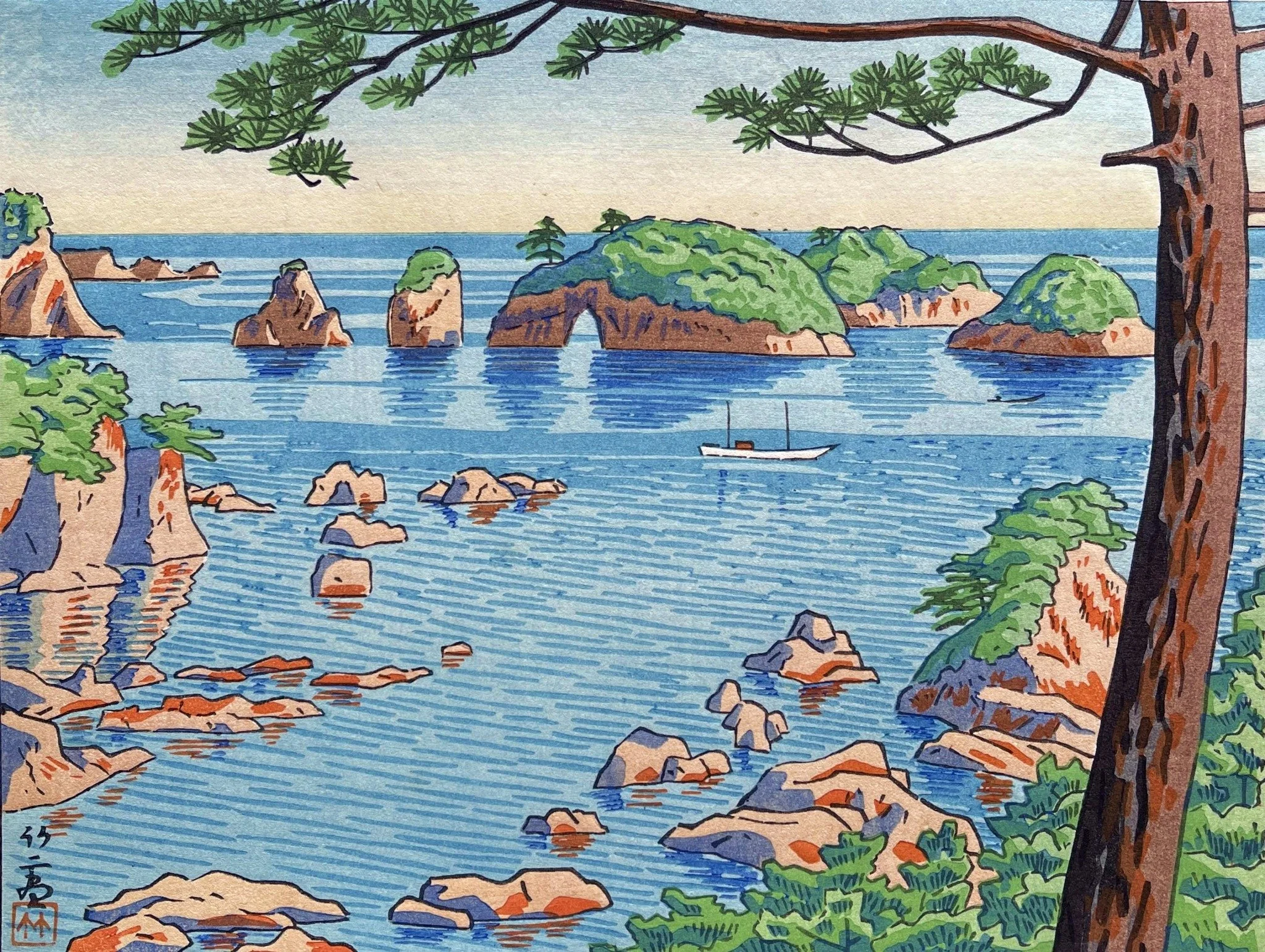
Bring the openness of a bright coastal landscape into your room. Asano Takeji’s Ki no Matsushima sets green islands and small boats within a wide expanse of blue, framed by the warm colour of a nearby pine. Reproduced on canvas over a sturdy 1.5-inch wood stretcher, the scene offers both clear structure and a welcoming sense of distance.
Product details: Canvas reproduction over a sturdy 1.5-inch wood stretcher. Available in 16 × 24 in. ($259 CAD) and 24 × 36 in. ($299 CAD). No returns accepted.
More About the Art
Ki no Matsushima opens a view across an island-filled sea while keeping the viewer close to the shore. A substantial pine trunk rises along the right edge, its long branches reaching across the top of the picture. Below this natural frame, rocks and low greenery lead toward open water. The landscape spreads horizontally, giving the separate islands room to establish their distinctive shapes against the pale sky.
The largest island occupies the middle of the scene. Its green crown slopes over reddish stone, with a dark opening breaking through the rock near its left side. Smaller formations stand nearby, some narrow and upright, others broad and rounded. Their differences give the view a lively rhythm. Each has enough definition to attract attention, while the repeated combination of green foliage and warm rock keeps them visually connected.
Water fills the spaces between these forms with an intricate pattern of blue. Short horizontal strokes gather beneath the islands, becoming darker where the reflections fall. Elsewhere, paler bands suggest the surface catching light. The marks vary in length and density without disturbing the overall calm. They make the sea feel active at a small scale, so that an apparently still view rewards closer attention.
A white boat rests near the centre of the water, its slim hull and two upright masts outlined with striking simplicity. A small warm-coloured structure sits between them. Farther back, a much smaller dark boat appears below the islands on the right. These vessels introduce a human scale without dominating the landscape. Their modest size makes the surrounding water feel generous and the rocky formations substantial.
The foreground pine is described through strong contrasts. Long dark marks cut through its reddish bark, while angular branches carry green clusters of needles across the sky. The nearby rocks share some of the trunk’s orange and brown tones, with blue-grey shadows sharpening their edges. This repeated warmth draws the foreground and islands together, balancing the large areas of cool blue water.
The title refers to Ki-no-Matsushima, a coastal group of islands at Nachikatsuura in Wakayama. Nanki Kumano Geopark describes the area’s varied island forms as the result of waves working on rock of different resistance, with sea caves developing along fractures. That setting gives the picture a specific geographic foundation. Asano’s arrangement makes the contrasts between solid rock and moving water immediately visible, without requiring the viewer to identify every island.
An Artelino catalogue record preserved by Ukiyo-e Search dates the design to around 1940; the date is approximate. This canvas reproduction presents the historical composition in a contemporary format. The image’s appeal lies in relationships that remain easy to enter: the large pine and small boats, the green island tops and reddish cliffs, and the open water linking the close shore with the horizon.
On a wall, the broad composition creates a feeling of looking outward. From a distance, the pine and islands establish a clear, colourful scene. Closer viewing reveals small rocks, reflections, individual needle marks and changes in the water’s blue. The eye can follow these details across the image without settling on one permanent centre, making the seascape an inviting companion for a living room, study or quiet reading space.
More About the Artist
Asano Takeji was a Kyoto-born Japanese artist whose work encompassed landscape views and imaginative woodblock compositions. He first trained as a painter, studying Japanese painting at Kyoto’s municipal painting school and graduating in 1923. He also explored oil painting before returning to Japanese painting. That early experience gave his development more than one direction, preceding the printmaking practice that would become central to his career.
In 1927 he studied with Tsuchida Bakusen and exhibited with the Kokuga Sōsaku Kyōkai. By around 1930 he was turning seriously toward woodblock prints, and in 1931 he committed his work to printmaking. This change followed several years of painting and experimentation. The clear shapes, organised colour and attention to a recognisable setting in his landscape prints offer one way to consider how a painter’s concerns could find expression in another medium.
Asano also took part in the print culture developing around him. In 1931 he joined Tokuriki Tomikichirō and others in producing the print magazine Taishū Hanga. The British Museum records his first solo exhibition in 1942, followed by many more over the succeeding decades. These activities connect his practice with both shared publishing projects and the opportunity to present an individual body of work to an audience.
Kobayashi Kiyochika’s views of Tokyo were an important stimulus for his own images of notable places. Osaka Prefecture’s collection account traces Asano’s landscape series from 1931 to 1972, encompassing Kyoto, Osaka and locations and events elsewhere in Japan. Kyoto Seika University describes works developed from sketches of different places, with light and atmosphere shaping the familiar streets and scenery. The subject could be a city view, a temple approach or a landscape encountered through changing conditions.
Ki no Matsushima offers a clear example of the visual pleasures available in his landscape work. The islands are recognisable as physical places, yet their rounded greenery and angular cliffs also create an arrangement of colour and shape. The branching pine strengthens the outer frame, while small boats interrupt the horizontal water. An observed setting becomes a carefully organised picture, with the distant and nearby elements continually answering one another.
Alongside his landscape work, Asano developed freer compositions based on simplified people, animals and other forms. In this creative print practice, he could draw, carve and print the work himself. Museum accounts emphasise the bold shapes, concise colours and humour of these images. Such work shows another side of his art, in which an observed subject could be transformed through playful changes of proportion, outline and arrangement.
An encounter with the American artist Ben Shahn became part of that later story. Fuchu Art Museum records Shahn’s visit to Asano’s Kyoto studio in 1960 and the exchange that began between the two artists. The museum’s retrospective brings his lively creative prints together with the earlier landscape views, allowing their differences to be seen within one career. A scene of a familiar place and an imaginative animal image can offer distinct expressions of the same artist’s interest in form.
Public collections preserve a substantial body of this work. In 1994, Asano donated 160 woodblock prints to Osaka Prefecture. Kyoto Seika University later received approximately 1,500 works through a donation from his family. These holdings make it possible to examine the range of his subjects and approaches, from images of specific places to more freely invented compositions, and to see how varied a long engagement with woodblock printing can become.
Returning to this seascape, its clarity provides a direct introduction to Asano’s art. The scene can be enjoyed as a bright coastal view, then reconsidered through the relationships that give it structure. Green recurs from the nearby plants to the distant islands; warm stone answers warm bark; blue shadows connect the water and shore. These connections hold the many small details together, allowing the picture to feel spacious without losing its strong sense of design.
Sources
Premium quality canvas print of Asano Takeji’s “Ki no Matsushima”
Bring the openness of a bright coastal landscape into your room. Asano Takeji’s Ki no Matsushima sets green islands and small boats within a wide expanse of blue, framed by the warm colour of a nearby pine. Reproduced on canvas over a sturdy 1.5-inch wood stretcher, the scene offers both clear structure and a welcoming sense of distance.
Product details: Canvas reproduction over a sturdy 1.5-inch wood stretcher. Available in 16 × 24 in. ($259 CAD) and 24 × 36 in. ($299 CAD). No returns accepted.
More About the Art
Ki no Matsushima opens a view across an island-filled sea while keeping the viewer close to the shore. A substantial pine trunk rises along the right edge, its long branches reaching across the top of the picture. Below this natural frame, rocks and low greenery lead toward open water. The landscape spreads horizontally, giving the separate islands room to establish their distinctive shapes against the pale sky.
The largest island occupies the middle of the scene. Its green crown slopes over reddish stone, with a dark opening breaking through the rock near its left side. Smaller formations stand nearby, some narrow and upright, others broad and rounded. Their differences give the view a lively rhythm. Each has enough definition to attract attention, while the repeated combination of green foliage and warm rock keeps them visually connected.
Water fills the spaces between these forms with an intricate pattern of blue. Short horizontal strokes gather beneath the islands, becoming darker where the reflections fall. Elsewhere, paler bands suggest the surface catching light. The marks vary in length and density without disturbing the overall calm. They make the sea feel active at a small scale, so that an apparently still view rewards closer attention.
A white boat rests near the centre of the water, its slim hull and two upright masts outlined with striking simplicity. A small warm-coloured structure sits between them. Farther back, a much smaller dark boat appears below the islands on the right. These vessels introduce a human scale without dominating the landscape. Their modest size makes the surrounding water feel generous and the rocky formations substantial.
The foreground pine is described through strong contrasts. Long dark marks cut through its reddish bark, while angular branches carry green clusters of needles across the sky. The nearby rocks share some of the trunk’s orange and brown tones, with blue-grey shadows sharpening their edges. This repeated warmth draws the foreground and islands together, balancing the large areas of cool blue water.
The title refers to Ki-no-Matsushima, a coastal group of islands at Nachikatsuura in Wakayama. Nanki Kumano Geopark describes the area’s varied island forms as the result of waves working on rock of different resistance, with sea caves developing along fractures. That setting gives the picture a specific geographic foundation. Asano’s arrangement makes the contrasts between solid rock and moving water immediately visible, without requiring the viewer to identify every island.
An Artelino catalogue record preserved by Ukiyo-e Search dates the design to around 1940; the date is approximate. This canvas reproduction presents the historical composition in a contemporary format. The image’s appeal lies in relationships that remain easy to enter: the large pine and small boats, the green island tops and reddish cliffs, and the open water linking the close shore with the horizon.
On a wall, the broad composition creates a feeling of looking outward. From a distance, the pine and islands establish a clear, colourful scene. Closer viewing reveals small rocks, reflections, individual needle marks and changes in the water’s blue. The eye can follow these details across the image without settling on one permanent centre, making the seascape an inviting companion for a living room, study or quiet reading space.
More About the Artist
Asano Takeji was a Kyoto-born Japanese artist whose work encompassed landscape views and imaginative woodblock compositions. He first trained as a painter, studying Japanese painting at Kyoto’s municipal painting school and graduating in 1923. He also explored oil painting before returning to Japanese painting. That early experience gave his development more than one direction, preceding the printmaking practice that would become central to his career.
In 1927 he studied with Tsuchida Bakusen and exhibited with the Kokuga Sōsaku Kyōkai. By around 1930 he was turning seriously toward woodblock prints, and in 1931 he committed his work to printmaking. This change followed several years of painting and experimentation. The clear shapes, organised colour and attention to a recognisable setting in his landscape prints offer one way to consider how a painter’s concerns could find expression in another medium.
Asano also took part in the print culture developing around him. In 1931 he joined Tokuriki Tomikichirō and others in producing the print magazine Taishū Hanga. The British Museum records his first solo exhibition in 1942, followed by many more over the succeeding decades. These activities connect his practice with both shared publishing projects and the opportunity to present an individual body of work to an audience.
Kobayashi Kiyochika’s views of Tokyo were an important stimulus for his own images of notable places. Osaka Prefecture’s collection account traces Asano’s landscape series from 1931 to 1972, encompassing Kyoto, Osaka and locations and events elsewhere in Japan. Kyoto Seika University describes works developed from sketches of different places, with light and atmosphere shaping the familiar streets and scenery. The subject could be a city view, a temple approach or a landscape encountered through changing conditions.
Ki no Matsushima offers a clear example of the visual pleasures available in his landscape work. The islands are recognisable as physical places, yet their rounded greenery and angular cliffs also create an arrangement of colour and shape. The branching pine strengthens the outer frame, while small boats interrupt the horizontal water. An observed setting becomes a carefully organised picture, with the distant and nearby elements continually answering one another.
Alongside his landscape work, Asano developed freer compositions based on simplified people, animals and other forms. In this creative print practice, he could draw, carve and print the work himself. Museum accounts emphasise the bold shapes, concise colours and humour of these images. Such work shows another side of his art, in which an observed subject could be transformed through playful changes of proportion, outline and arrangement.
An encounter with the American artist Ben Shahn became part of that later story. Fuchu Art Museum records Shahn’s visit to Asano’s Kyoto studio in 1960 and the exchange that began between the two artists. The museum’s retrospective brings his lively creative prints together with the earlier landscape views, allowing their differences to be seen within one career. A scene of a familiar place and an imaginative animal image can offer distinct expressions of the same artist’s interest in form.
Public collections preserve a substantial body of this work. In 1994, Asano donated 160 woodblock prints to Osaka Prefecture. Kyoto Seika University later received approximately 1,500 works through a donation from his family. These holdings make it possible to examine the range of his subjects and approaches, from images of specific places to more freely invented compositions, and to see how varied a long engagement with woodblock printing can become.
Returning to this seascape, its clarity provides a direct introduction to Asano’s art. The scene can be enjoyed as a bright coastal view, then reconsidered through the relationships that give it structure. Green recurs from the nearby plants to the distant islands; warm stone answers warm bark; blue shadows connect the water and shore. These connections hold the many small details together, allowing the picture to feel spacious without losing its strong sense of design.
Sources for the artwork and artist
- Ohmi Gallery — Asano Takeji, Ki no Matsushima
- Artelino catalogue via Ukiyo-e Search — Ki no Matsushima Islands, c. 1940
- Nanki Kumano Geopark — Ki-no-Matsushima Islands
- Onomichi City Museum of Art — Asano Takeji and artist chronology
- British Museum — Asano Takeji, artist biography
- Osaka Prefecture, enoco — Asano Takeji and the prefectural collection
- Fuchu Art Museum — The Woodblock World of Asano Takeji
- Kyoto Seika University — Asano Takeji’s landscape prints and collection