
Japanese art on canvas
Full Moon over Matsuyama Castle
Kawase Hasui · 1953
From $259 CAD
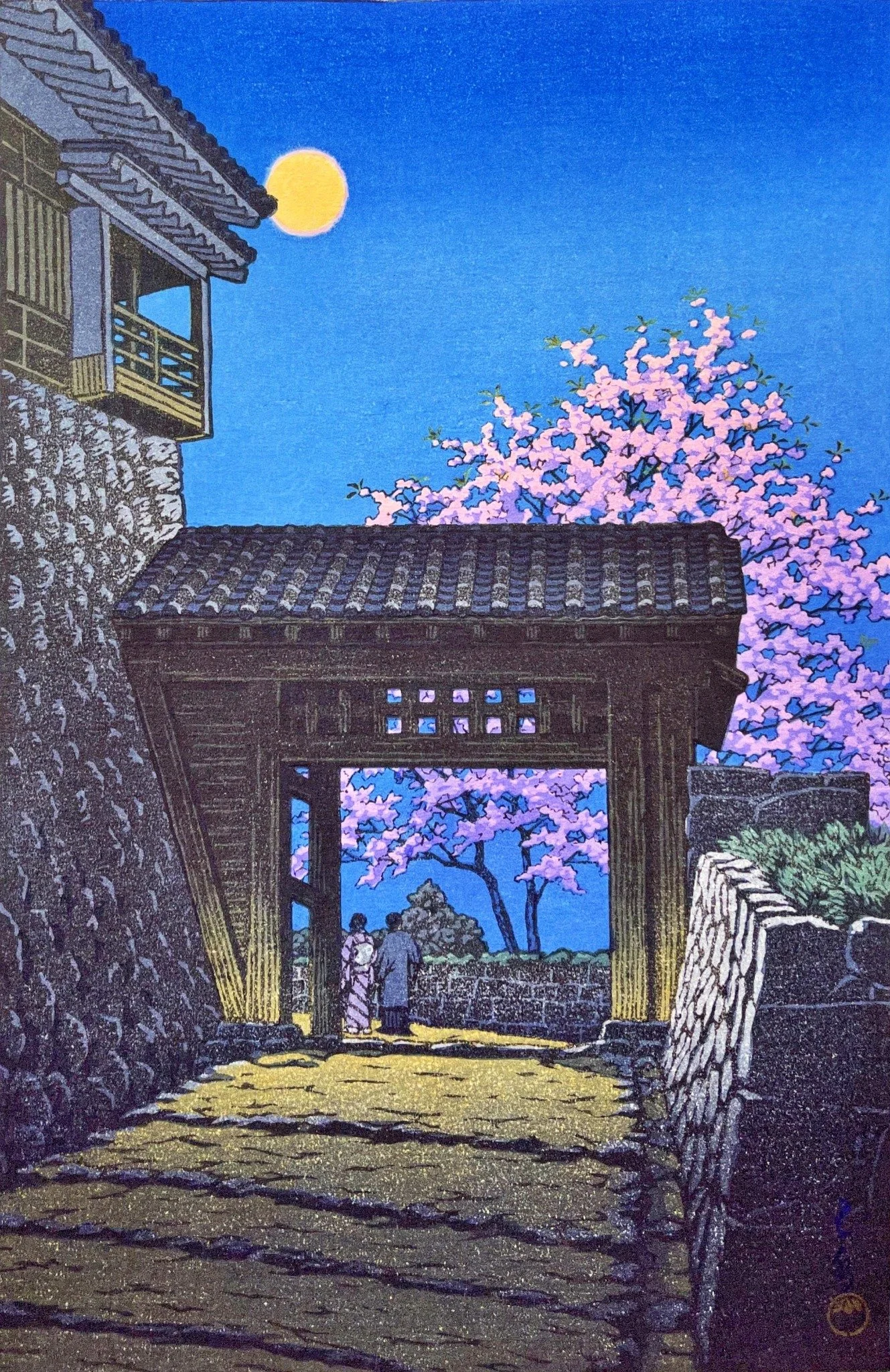
A golden moon, pink cherry blossoms, and a quiet castle gateway create a luminous evening retreat. Kawase Hasui’s Full Moon over Matsuyama Castle brings serene colour and historic Japanese architecture into your home as a portrait canvas reproduction over a sturdy 1.5-inch wood stretcher.
| 16 × 24 in. | $259 CAD |
|---|---|
| 24 × 36 in. | $299 CAD |
Choose your canvas size and quantity below. All prices are in CAD.
Artwork titles and dates identify the original work. Review the product details and available options before ordering.
Ask about this print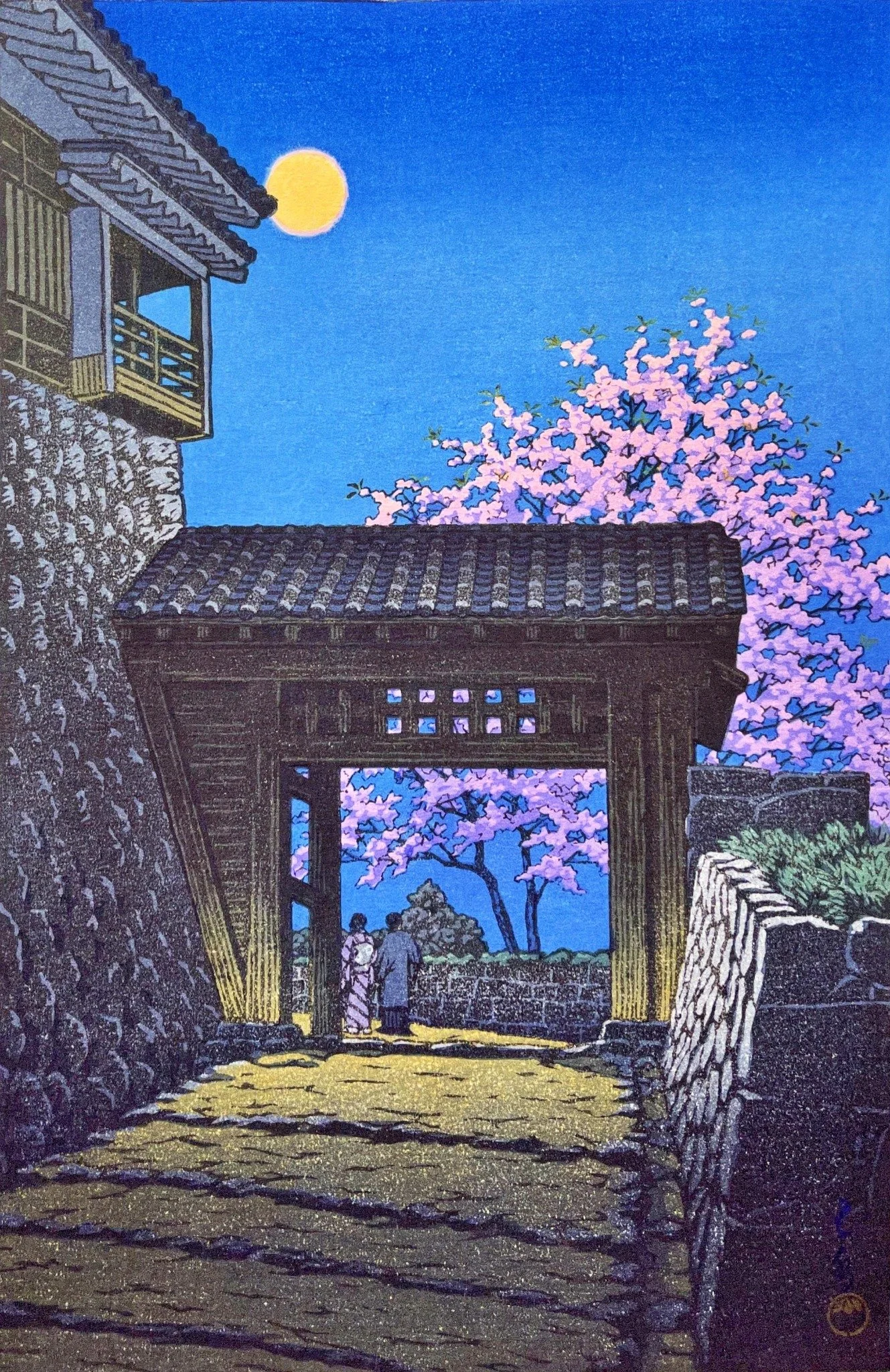
Premium quality canvas print of “Full Moon over Matsuyama Castle” by Kawase Hasui
A golden moon, pink cherry blossoms, and a quiet castle gateway create a luminous evening retreat. Kawase Hasui’s Full Moon over Matsuyama Castle brings serene colour and historic Japanese architecture into your home as a portrait canvas reproduction over a sturdy 1.5-inch wood stretcher.
Product details: Canvas reproduction over a sturdy 1.5-inch wood stretcher. Available in 16 × 24 in. ($259 CAD) and 24 × 36 in. ($299 CAD). No returns accepted.
More About the Art
A full yellow moon shines beside the tiled eaves of Matsuyama Castle, illuminating a quiet meeting of stone, timber, and cherry blossom. Kawase Hasui brings the viewer close to the castle approach, where a dark wooden gate spans the path and pink flowers rise beyond its roof. Two small figures stand beneath the opening. Around them, the expansive blue sky gives this intimate architectural view a feeling of generous, unhurried space.
The foreground establishes the solid character of the place. An uneven stone path leads upward between walls, its warm surface broken by dark joints and shadow. On the left, the high masonry rises steeply toward the cropped building above. On the right, a lower wall angles inward, guiding the eye toward the gate. The varied sizes and tones of the stones make this narrow approach feel substantial and closely observed.
Across the middle of the composition, the gate forms a strong horizontal presence. Rows of curved roof tiles catch subtle changes of grey and blue, while heavy posts and beams frame the view beyond. Small square openings admit glimpses of light colour through the upper woodwork. The structure’s dark surfaces give the blossoms behind it particular brilliance, allowing the tree to appear both above the roof and within the rectangular opening below.
Hasui makes the cherry tree a lively counterpart to the architecture. Pink and pale lavender flowers gather along slender branches, interrupted by small touches of green. Their irregular shapes spread upward and across the right side, softening the gate’s measured lines. Beyond the opening, a divided trunk rises behind the two figures. The people remain small and simply described, giving the stonework, gate, and tree a human scale without becoming the scene’s dominant subject.
The moon balances this abundance of blossom with a single clear circle. Its warm yellow stands against the broad blue sky, close to the projecting roof at the upper left. Hasui leaves much of that sky open, creating a calm interval between moon, roof, and flowers. Warm colour reappears along the path and at the foot of the gateposts, linking the distant light with the route the viewer is invited to follow.
Known in Japanese as Matsuyama-jō meigetsu, 松山城名月, this colour woodblock design dates to December 1953 and was published by Watanabe Shōzaburō. The setting is Matsuyama Castle in Ehime Prefecture. The wooden structure is Tonashimon, the “doorless gate.” The castle’s official guide explains that it has always lacked gate leaves. Hasui chooses this close approach to the historic site, concentrating on its textures and atmosphere rather than offering a distant panorama of the entire castle.
This portrait canvas reproduction preserves the supplied image composition, including the high moon, tiled eaves, flowering cherry tree, two figures, and foreground path. At a distance, its meeting of pink blossom and clear blue creates a luminous presence. Closer looking reveals the many quieter details that sustain it: roof tiles, timber grain, angled stones, small openings, and the pauses between flower clusters. Together, they hold a moment of evening stillness within the enduring forms of the castle.
More About the Artist
Kawase Hasui (1883–1957) was a leading landscape designer of shin-hanga, the twentieth-century renewal of Japanese woodblock printing. He gave carefully observed places an expressive atmosphere through changing light, weather, and season. In Full Moon over Matsuyama Castle, the setting is immediately tangible through stone walls and dark timber, while moonlight and cherry blossoms lend the architectural view an intimate, lyrical character. Such relationships between enduring places and passing conditions are central to his work.
Born in Tokyo with the given name Bunjiro, Hasui trained in Western-style painting under Okada Saburosuke and became a student of Kaburaki Kiyokata in 1910. His education connected different approaches to colour, line, and pictorial space. The narrow castle path demonstrates the ease with which these could work together: converging walls establish depth, firm outlines clarify the gate, and broad passages of blue allow the eye to rest beyond the densely described surfaces.
Watanabe Shōzaburō published Hasui’s first landscape prints in 1918–19, establishing a collaboration that continued through much of the artist’s career. Watanabe was an important advocate of shin-hanga, supporting the specialized craft needed to create contemporary images through traditional woodblocks. Hasui’s landscapes became a significant part of that enterprise. His subjects could be dramatic, but their feeling often depended on restrained details: a patch of light, a quiet figure, or a particular view through trees.
Woodblock production joined the work of designer, carver, printer, and publisher. Hasui determined the arrangement, while other skilled hands translated the image into carved surfaces and successive applications of colour. The Matsuyama view makes this shared expertise especially apparent. Roof tiles require repeated, precise forms; rough masonry calls for varied marks; blossoms need clear shapes without losing their lightness. Broad blue passages then bring these distinct textures into a unified atmosphere.
Travel remained a source of his imagery throughout his working life. Hasui visited well-known sites as well as less celebrated streets, waterways, villages, and coastal settings. The Ōta Museum’s account of his postwar journeys records him sketching Matsuyama Castle’s Tonashimon during a trip in 1948. The finished print is dated December 1953. That interval offers a concrete example of how an observed place could remain available for later development within his printmaking practice.
His career continued through periods of profound disruption. The Great Kantō Earthquake of 1923 destroyed Watanabe’s premises, print stock, and woodblocks, and Hasui lost sketchbooks. He went on to create new designs and continued working after the Second World War. His complete output exceeded six hundred print designs. Illustrations for magazines, menus, posters, and postcards also formed part of his activity, revealing an artist experienced in bringing images to different audiences and settings.
In 1953, the making of Snow at Zōjōji Temple was documented by Japan’s Cultural Properties Protection Committee. That attention to the production process helps illuminate the accomplished collaboration behind his landscapes. Full Moon over Matsuyama Castle belongs to the same late period of his career. It expresses a mature balance between detailed construction and open space, allowing stone, wood, blossom, and moon to retain distinct characters within one quiet view.
Hasui’s lasting appeal can be felt in the way the image welcomes patient attention. The small figures make the gateway approachable, the flowers offer a delicate seasonal presence, and the moon gives the scene a steady focus. Nothing requires a hurried response. Through a particular Japanese castle entrance, he creates an experience of looking that remains both grounded in place and open to personal reflection.
Sources for the artwork and artist
Premium quality canvas print of “Full Moon over Matsuyama Castle” by Kawase Hasui
A golden moon, pink cherry blossoms, and a quiet castle gateway create a luminous evening retreat. Kawase Hasui’s Full Moon over Matsuyama Castle brings serene colour and historic Japanese architecture into your home as a portrait canvas reproduction over a sturdy 1.5-inch wood stretcher.
Product details: Canvas reproduction over a sturdy 1.5-inch wood stretcher. Available in 16 × 24 in. ($259 CAD) and 24 × 36 in. ($299 CAD). No returns accepted.
More About the Art
A full yellow moon shines beside the tiled eaves of Matsuyama Castle, illuminating a quiet meeting of stone, timber, and cherry blossom. Kawase Hasui brings the viewer close to the castle approach, where a dark wooden gate spans the path and pink flowers rise beyond its roof. Two small figures stand beneath the opening. Around them, the expansive blue sky gives this intimate architectural view a feeling of generous, unhurried space.
The foreground establishes the solid character of the place. An uneven stone path leads upward between walls, its warm surface broken by dark joints and shadow. On the left, the high masonry rises steeply toward the cropped building above. On the right, a lower wall angles inward, guiding the eye toward the gate. The varied sizes and tones of the stones make this narrow approach feel substantial and closely observed.
Across the middle of the composition, the gate forms a strong horizontal presence. Rows of curved roof tiles catch subtle changes of grey and blue, while heavy posts and beams frame the view beyond. Small square openings admit glimpses of light colour through the upper woodwork. The structure’s dark surfaces give the blossoms behind it particular brilliance, allowing the tree to appear both above the roof and within the rectangular opening below.
Hasui makes the cherry tree a lively counterpart to the architecture. Pink and pale lavender flowers gather along slender branches, interrupted by small touches of green. Their irregular shapes spread upward and across the right side, softening the gate’s measured lines. Beyond the opening, a divided trunk rises behind the two figures. The people remain small and simply described, giving the stonework, gate, and tree a human scale without becoming the scene’s dominant subject.
The moon balances this abundance of blossom with a single clear circle. Its warm yellow stands against the broad blue sky, close to the projecting roof at the upper left. Hasui leaves much of that sky open, creating a calm interval between moon, roof, and flowers. Warm colour reappears along the path and at the foot of the gateposts, linking the distant light with the route the viewer is invited to follow.
Known in Japanese as Matsuyama-jō meigetsu, 松山城名月, this colour woodblock design dates to December 1953 and was published by Watanabe Shōzaburō. The setting is Matsuyama Castle in Ehime Prefecture. The wooden structure is Tonashimon, the “doorless gate.” The castle’s official guide explains that it has always lacked gate leaves. Hasui chooses this close approach to the historic site, concentrating on its textures and atmosphere rather than offering a distant panorama of the entire castle.
This portrait canvas reproduction preserves the supplied image composition, including the high moon, tiled eaves, flowering cherry tree, two figures, and foreground path. At a distance, its meeting of pink blossom and clear blue creates a luminous presence. Closer looking reveals the many quieter details that sustain it: roof tiles, timber grain, angled stones, small openings, and the pauses between flower clusters. Together, they hold a moment of evening stillness within the enduring forms of the castle.
More About the Artist
Kawase Hasui (1883–1957) was a leading landscape designer of shin-hanga, the twentieth-century renewal of Japanese woodblock printing. He gave carefully observed places an expressive atmosphere through changing light, weather, and season. In Full Moon over Matsuyama Castle, the setting is immediately tangible through stone walls and dark timber, while moonlight and cherry blossoms lend the architectural view an intimate, lyrical character. Such relationships between enduring places and passing conditions are central to his work.
Born in Tokyo with the given name Bunjiro, Hasui trained in Western-style painting under Okada Saburosuke and became a student of Kaburaki Kiyokata in 1910. His education connected different approaches to colour, line, and pictorial space. The narrow castle path demonstrates the ease with which these could work together: converging walls establish depth, firm outlines clarify the gate, and broad passages of blue allow the eye to rest beyond the densely described surfaces.
Watanabe Shōzaburō published Hasui’s first landscape prints in 1918–19, establishing a collaboration that continued through much of the artist’s career. Watanabe was an important advocate of shin-hanga, supporting the specialized craft needed to create contemporary images through traditional woodblocks. Hasui’s landscapes became a significant part of that enterprise. His subjects could be dramatic, but their feeling often depended on restrained details: a patch of light, a quiet figure, or a particular view through trees.
Woodblock production joined the work of designer, carver, printer, and publisher. Hasui determined the arrangement, while other skilled hands translated the image into carved surfaces and successive applications of colour. The Matsuyama view makes this shared expertise especially apparent. Roof tiles require repeated, precise forms; rough masonry calls for varied marks; blossoms need clear shapes without losing their lightness. Broad blue passages then bring these distinct textures into a unified atmosphere.
Travel remained a source of his imagery throughout his working life. Hasui visited well-known sites as well as less celebrated streets, waterways, villages, and coastal settings. The Ōta Museum’s account of his postwar journeys records him sketching Matsuyama Castle’s Tonashimon during a trip in 1948. The finished print is dated December 1953. That interval offers a concrete example of how an observed place could remain available for later development within his printmaking practice.
His career continued through periods of profound disruption. The Great Kantō Earthquake of 1923 destroyed Watanabe’s premises, print stock, and woodblocks, and Hasui lost sketchbooks. He went on to create new designs and continued working after the Second World War. His complete output exceeded six hundred print designs. Illustrations for magazines, menus, posters, and postcards also formed part of his activity, revealing an artist experienced in bringing images to different audiences and settings.
In 1953, the making of Snow at Zōjōji Temple was documented by Japan’s Cultural Properties Protection Committee. That attention to the production process helps illuminate the accomplished collaboration behind his landscapes. Full Moon over Matsuyama Castle belongs to the same late period of his career. It expresses a mature balance between detailed construction and open space, allowing stone, wood, blossom, and moon to retain distinct characters within one quiet view.
Hasui’s lasting appeal can be felt in the way the image welcomes patient attention. The small figures make the gateway approachable, the flowers offer a delicate seasonal presence, and the moon gives the scene a steady focus. Nothing requires a hurried response. Through a particular Japanese castle entrance, he creates an experience of looking that remains both grounded in place and open to personal reflection.
Sources for the artwork and artist
- Aichi Prefectural Museum of Art — Matsuyama-jō meigetsu; 1953 woodblock, Japanese title and artist dates
- Ōta Museum — curator’s column 14; December 1953 print and Hasui’s 1948 visit to sketch Tonashimon
- S. Watanabe Color Print Co. — H-38, Cherry Blossom and Moon at Matsuyama Castle; 1953 design and publisher
- Matsuyama Castle — official architecture guide; Tonashimon, its construction and the absence of gate leaves
- British Museum — Kawase Hasui; Kiyokata, Watanabe and the first landscape prints of 1918–19
- Tokyo Fuji Art Museum — Kawase Hasui; artistic training and the 1953 documentation of woodblock production
- Japan Museum SieboldHuis — Kawase Hasui: Capturing the Soul of Japan; travel, collaborative printmaking, earthquake losses and career