
Japanese art on canvas
Fireflies and Lighted House
After Kobayashi Kiyochika
From $259 CAD
A canvas reproduction of Fireflies and Lighted House, presented on a 1.5-inch wood stretcher.
| 16 × 24 in. | $259 CAD |
|---|---|
| 24 × 36 in. | $299 CAD |
Choose your canvas size and quantity below. All prices are in CAD.
Artwork titles and dates identify the original work. Review the product details and available options before ordering.
Ask about this printPremium quality canvas print of “Fireflies and Lighted House”, after Kobayashi Kiyochika
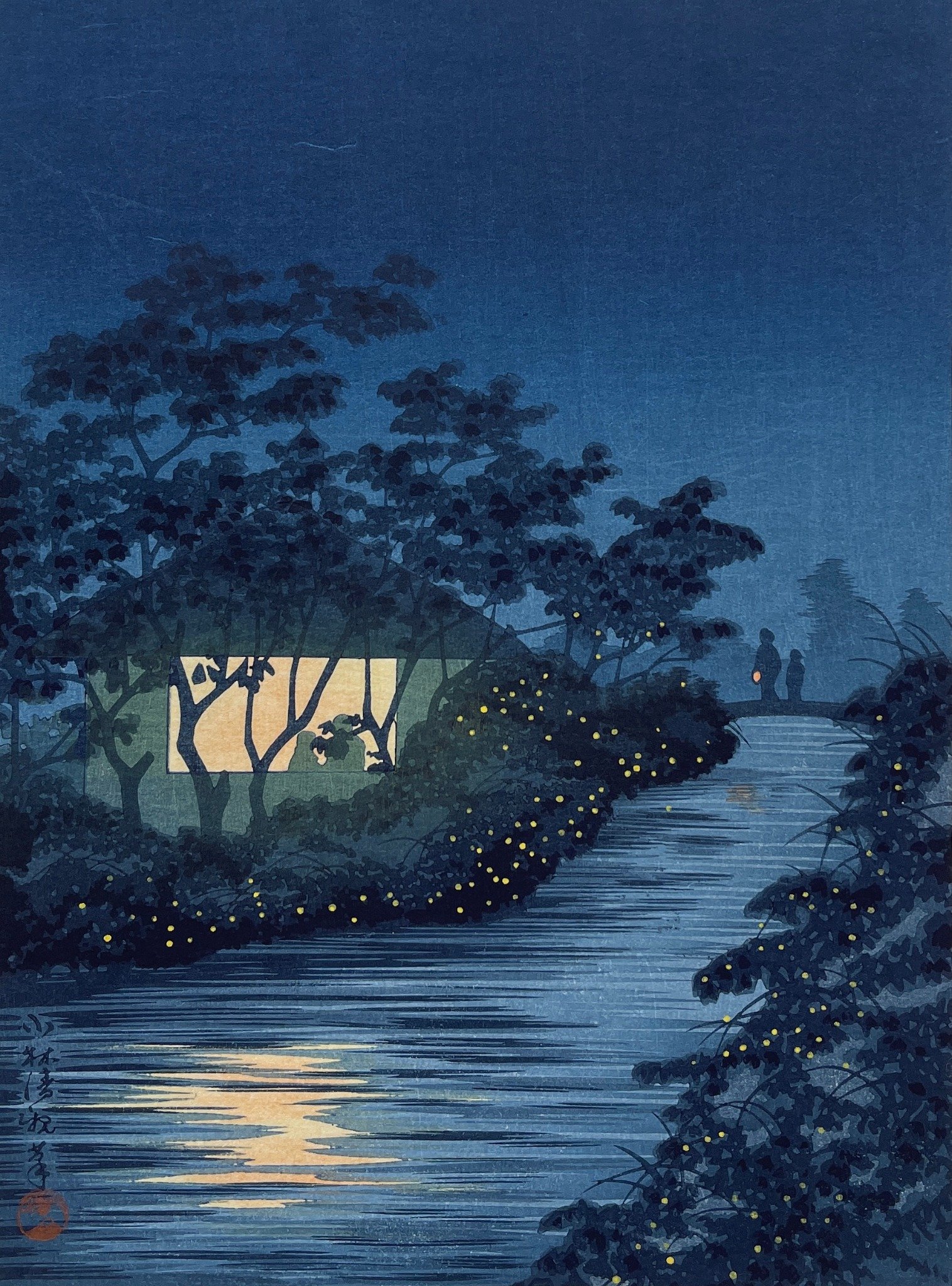
Bring a small constellation of light into your room. Fireflies and Lighted House, after Kobayashi Kiyochika, pairs a warmly glowing window with delicate fireflies along a quiet stream. Reproduced on canvas over a sturdy 1.5-inch wood stretcher, its deep blues and soft gold accents create an intimate night scene with an inviting sense of depth.
Product details: Canvas reproduction over a sturdy 1.5-inch wood stretcher. Available in 16 × 24 in. ($259 CAD) and 24 × 36 in. ($299 CAD). No returns accepted.
More About the Art
Fireflies and Lighted House follows a stream into the depths of a blue night. The water enters broadly at the bottom, then narrows toward a small footbridge in the distance. Dense plants border both banks, while a house is partly hidden behind trees on the left. Its bright window becomes the scene’s strongest source of warmth, balanced by scattered yellow points among the dark leaves.
The trees create a layered screen in front of the building. Branches and slender trunks cross the glowing window, turning familiar plant forms into sharply defined silhouettes. Above it, rounded leaves gather into a much darker canopy. The house itself remains largely concealed. This partial view gives the light a sheltered character, suggesting a space within the landscape while leaving the surrounding night generous and open.
Fireflies gather along the water’s edge in loose, irregular groups. Some appear close together among the plants; others stand apart against the deeper shadows. Their small yellow marks carry the eye from the left bank toward the near foliage on the right. Unlike the broad light of the window, these tiny accents have a scattered rhythm, making the darkness feel alive with points of attention.
The stream is described through fine horizontal bands of blue, pale grey and dark ink-like colour. Near the foreground, gold spreads into a broken reflection beneath the house. Its shape changes from one line to the next, allowing the water to retain a sense of gentle movement. Farther upstream, the marks become smaller and more closely packed, reinforcing the distance between the viewer and the footbridge.
Two small figures stand on that bridge, one taller than the other. A warm orange light appears beside the taller silhouette, with a faint reflection in the water below. Their simple outlines are enough to introduce another scale into the picture. Set between the nearby vegetation and the dim forms beyond, the figures help draw the eye through the landscape without turning the scene into a fully explained narrative.
Above the trees, a large field of blue sky occupies the upper part of the portrait. There is no visible moon; the scene’s light comes from the window, the fireflies and the small distant glow. The open sky gives these low-placed details room to breathe. It also slows the movement of the composition, balancing the intricate banks and rippling water with an expanse of comparatively uninterrupted colour.
This vertical scene is a later adaptation after Kobayashi Kiyochika’s horizontal composition The Koromogawa River beside Tennoji Temple, which Edo-Tokyo Museum dates to 1880. The UnitedArts canvas reproduces the later portrait arrangement. The credit “after Kobayashi Kiyochika” acknowledges that relationship, while keeping the earlier composition’s date distinct from this adapted view. The attraction remains the close relationship between reflected light, dark foliage and small human figures.
In a living room or study, the image offers a quiet focal point that grows richer as you approach. The warm window is immediately legible from across a room. Closer viewing brings out the fireflies, the overlapping branches and the long succession of water marks. These details create a gentle path through the picture, inviting the eye to travel from the foreground reflection toward the bridge and back again.
More About the Artist
Kobayashi Kiyochika (1847–1915) lived through the transformation of Edo into modern Tokyo. Born in the old capital, he served as a minor retainer of the Tokugawa shogunate and left the city after its fall in 1868. When he returned in 1874, railways, steamships, gaslights, telegraph lines and large brick buildings were changing its appearance. This altered setting became an important subject in his development as an artist.
Little is securely known about his formal artistic education. LACMA describes him as generally considered self-taught, with an interest in both Japanese traditions and newer Western formats and processes. He explored ways of bringing the effects of painting, photography and other print techniques into woodblock images. That openness helps account for work in which a familiar place can be shaped as strongly by tone and illumination as by a clearly drawn outline.
Between 1876 and 1881, he created the series commonly known as Famous Places of Tokyo. The ninety-three completed views included twenty-five night scenes, according to MIT’s scholarly study of the series. Streets, waterways and buildings appear through changing conditions rather than a single uniform daylight. The city is recognisable, but its atmosphere can feel uncertain, quiet or newly unfamiliar as older surroundings coexist with modern structures and technologies.
These works are associated with kōsen-ga, or pictures concerned with rays of light. Kiyochika explored dawn, dusk and night through sources as varied as the sun, moon, lanterns, lightning and fire. LACMA’s curatorial account draws attention to reflections on water and wet streets, and to the use of clouds, rain, smoke and fog. Light becomes part of the structure of a scene, revealing some forms while allowing others to recede.
The historical woodblock medium made such effects a collaborative achievement. A designer’s image was translated into carved blocks and printed in stages, with a publisher organising the work. As the Metropolitan Museum of Art explains, separate colour blocks and alignment guides allowed repeated impressions to build a complete image. Fine lines and larger areas of colour could therefore work together, creating detailed surroundings within a coherent overall atmosphere.
Kiyochika’s career extended beyond his landscape views. Kitakyushu Municipal Museum of Art records his turn toward journalism and a series of satirical images beginning in 1881. His broader output also included historical subjects and battle triptychs associated with the Sino-Japanese War of 1894–95. These different forms show an artist responding to public life as well as to the city’s visible spaces, using the print as a means of observation and commentary.
His approach also reached a younger generation. Inoue Yasuji and Tsuchiya Koitsu both studied with him, and Chigasaki City Museum of Art has examined their work together as part of the development of modern Japanese landscape. Its account describes Koitsu as continuing aspects of Kiyochika’s treatment of space and becoming especially accomplished in night views. That connection places the handling of shadow and atmosphere within a continuing artistic exchange.
Interest in Kiyochika’s Tokyo landscapes revived in the 1910s. The Smithsonian describes writers and intellectuals returning to them as images through which to consider the changes of modern life. Later museum study has continued to examine their distinctive treatment of the city. Such attention helps explain why these prints remain useful both as historical views and as images whose emotional character depends on subtle relationships of light and darkness.
The later adaptation reproduced here offers one way to encounter that interest in illumination. Its window, reflected gold and tiny fireflies create several scales of brightness within the same night. Looking between them reveals how much a scene can communicate through a restrained set of colours. The pleasure lies in that gradual discovery: a bank of foliage, a distant figure and a patch of water each become visible through their relationship to the light.
Sources
Edo-Tokyo Museum — The Koromogawa River beside Tennoji Temple, 1880
Smithsonian National Museum of Asian Art — Kiyochika: Master of the Night
LACMA — View of Umaya Bridge and Kiyochika’s treatment of light
Kitakyushu Municipal Museum of Art — Kobayashi Kiyochika, artist biography
The Metropolitan Museum of Art — Woodblock Prints in the Ukiyo-e Style
Smithsonian National Museum of Asian Art — Koromogawa River at Tennōji-shita, 1880
Premium quality canvas print of “Fireflies and Lighted House”, after Kobayashi Kiyochika
Bring a small constellation of light into your room. Fireflies and Lighted House, after Kobayashi Kiyochika, pairs a warmly glowing window with delicate fireflies along a quiet stream. Reproduced on canvas over a sturdy 1.5-inch wood stretcher, its deep blues and soft gold accents create an intimate night scene with an inviting sense of depth.
Product details: Canvas reproduction over a sturdy 1.5-inch wood stretcher. Available in 16 × 24 in. ($259 CAD) and 24 × 36 in. ($299 CAD). No returns accepted.
More About the Art
Fireflies and Lighted House follows a stream into the depths of a blue night. The water enters broadly at the bottom, then narrows toward a small footbridge in the distance. Dense plants border both banks, while a house is partly hidden behind trees on the left. Its bright window becomes the scene’s strongest source of warmth, balanced by scattered yellow points among the dark leaves.
The trees create a layered screen in front of the building. Branches and slender trunks cross the glowing window, turning familiar plant forms into sharply defined silhouettes. Above it, rounded leaves gather into a much darker canopy. The house itself remains largely concealed. This partial view gives the light a sheltered character, suggesting a space within the landscape while leaving the surrounding night generous and open.
Fireflies gather along the water’s edge in loose, irregular groups. Some appear close together among the plants; others stand apart against the deeper shadows. Their small yellow marks carry the eye from the left bank toward the near foliage on the right. Unlike the broad light of the window, these tiny accents have a scattered rhythm, making the darkness feel alive with points of attention.
The stream is described through fine horizontal bands of blue, pale grey and dark ink-like colour. Near the foreground, gold spreads into a broken reflection beneath the house. Its shape changes from one line to the next, allowing the water to retain a sense of gentle movement. Farther upstream, the marks become smaller and more closely packed, reinforcing the distance between the viewer and the footbridge.
Two small figures stand on that bridge, one taller than the other. A warm orange light appears beside the taller silhouette, with a faint reflection in the water below. Their simple outlines are enough to introduce another scale into the picture. Set between the nearby vegetation and the dim forms beyond, the figures help draw the eye through the landscape without turning the scene into a fully explained narrative.
Above the trees, a large field of blue sky occupies the upper part of the portrait. There is no visible moon; the scene’s light comes from the window, the fireflies and the small distant glow. The open sky gives these low-placed details room to breathe. It also slows the movement of the composition, balancing the intricate banks and rippling water with an expanse of comparatively uninterrupted colour.
This vertical scene is a later adaptation after Kobayashi Kiyochika’s horizontal composition The Koromogawa River beside Tennoji Temple, which Edo-Tokyo Museum dates to 1880. The UnitedArts canvas reproduces the later portrait arrangement. The credit “after Kobayashi Kiyochika” acknowledges that relationship, while keeping the earlier composition’s date distinct from this adapted view. The attraction remains the close relationship between reflected light, dark foliage and small human figures.
In a living room or study, the image offers a quiet focal point that grows richer as you approach. The warm window is immediately legible from across a room. Closer viewing brings out the fireflies, the overlapping branches and the long succession of water marks. These details create a gentle path through the picture, inviting the eye to travel from the foreground reflection toward the bridge and back again.
More About the Artist
Kobayashi Kiyochika (1847–1915) lived through the transformation of Edo into modern Tokyo. Born in the old capital, he served as a minor retainer of the Tokugawa shogunate and left the city after its fall in 1868. When he returned in 1874, railways, steamships, gaslights, telegraph lines and large brick buildings were changing its appearance. This altered setting became an important subject in his development as an artist.
Little is securely known about his formal artistic education. LACMA describes him as generally considered self-taught, with an interest in both Japanese traditions and newer Western formats and processes. He explored ways of bringing the effects of painting, photography and other print techniques into woodblock images. That openness helps account for work in which a familiar place can be shaped as strongly by tone and illumination as by a clearly drawn outline.
Between 1876 and 1881, he created the series commonly known as Famous Places of Tokyo. The ninety-three completed views included twenty-five night scenes, according to MIT’s scholarly study of the series. Streets, waterways and buildings appear through changing conditions rather than a single uniform daylight. The city is recognisable, but its atmosphere can feel uncertain, quiet or newly unfamiliar as older surroundings coexist with modern structures and technologies.
These works are associated with kōsen-ga, or pictures concerned with rays of light. Kiyochika explored dawn, dusk and night through sources as varied as the sun, moon, lanterns, lightning and fire. LACMA’s curatorial account draws attention to reflections on water and wet streets, and to the use of clouds, rain, smoke and fog. Light becomes part of the structure of a scene, revealing some forms while allowing others to recede.
The historical woodblock medium made such effects a collaborative achievement. A designer’s image was translated into carved blocks and printed in stages, with a publisher organising the work. As the Metropolitan Museum of Art explains, separate colour blocks and alignment guides allowed repeated impressions to build a complete image. Fine lines and larger areas of colour could therefore work together, creating detailed surroundings within a coherent overall atmosphere.
Kiyochika’s career extended beyond his landscape views. Kitakyushu Municipal Museum of Art records his turn toward journalism and a series of satirical images beginning in 1881. His broader output also included historical subjects and battle triptychs associated with the Sino-Japanese War of 1894–95. These different forms show an artist responding to public life as well as to the city’s visible spaces, using the print as a means of observation and commentary.
His approach also reached a younger generation. Inoue Yasuji and Tsuchiya Koitsu both studied with him, and Chigasaki City Museum of Art has examined their work together as part of the development of modern Japanese landscape. Its account describes Koitsu as continuing aspects of Kiyochika’s treatment of space and becoming especially accomplished in night views. That connection places the handling of shadow and atmosphere within a continuing artistic exchange.
Interest in Kiyochika’s Tokyo landscapes revived in the 1910s. The Smithsonian describes writers and intellectuals returning to them as images through which to consider the changes of modern life. Later museum study has continued to examine their distinctive treatment of the city. Such attention helps explain why these prints remain useful both as historical views and as images whose emotional character depends on subtle relationships of light and darkness.
The later adaptation reproduced here offers one way to encounter that interest in illumination. Its window, reflected gold and tiny fireflies create several scales of brightness within the same night. Looking between them reveals how much a scene can communicate through a restrained set of colours. The pleasure lies in that gradual discovery: a bank of foliage, a distant figure and a patch of water each become visible through their relationship to the light.
Sources for the artwork and artist
- Edo-Tokyo Museum — The Koromogawa River beside Tennoji Temple, 1880
- Smithsonian National Museum of Asian Art — Kiyochika: Master of the Night
- LACMA — View of Umaya Bridge and Kiyochika’s treatment of light
- MIT Visualizing Cultures — Kiyochika’s Tokyo
- Kitakyushu Municipal Museum of Art — Kobayashi Kiyochika, artist biography
- The Metropolitan Museum of Art — Woodblock Prints in the Ukiyo-e Style
- Chigasaki City Museum of Art — Yasuji, Kiyochika and Koitsu
- Smithsonian National Museum of Asian Art — Koromogawa River at Tennōji-shita, 1880
- Shima Art Company catalogue — Fireflies on River Bank