
Japanese art on canvas
Evening at Ushibori
Kawase Hasui · 1930
From $259 CAD
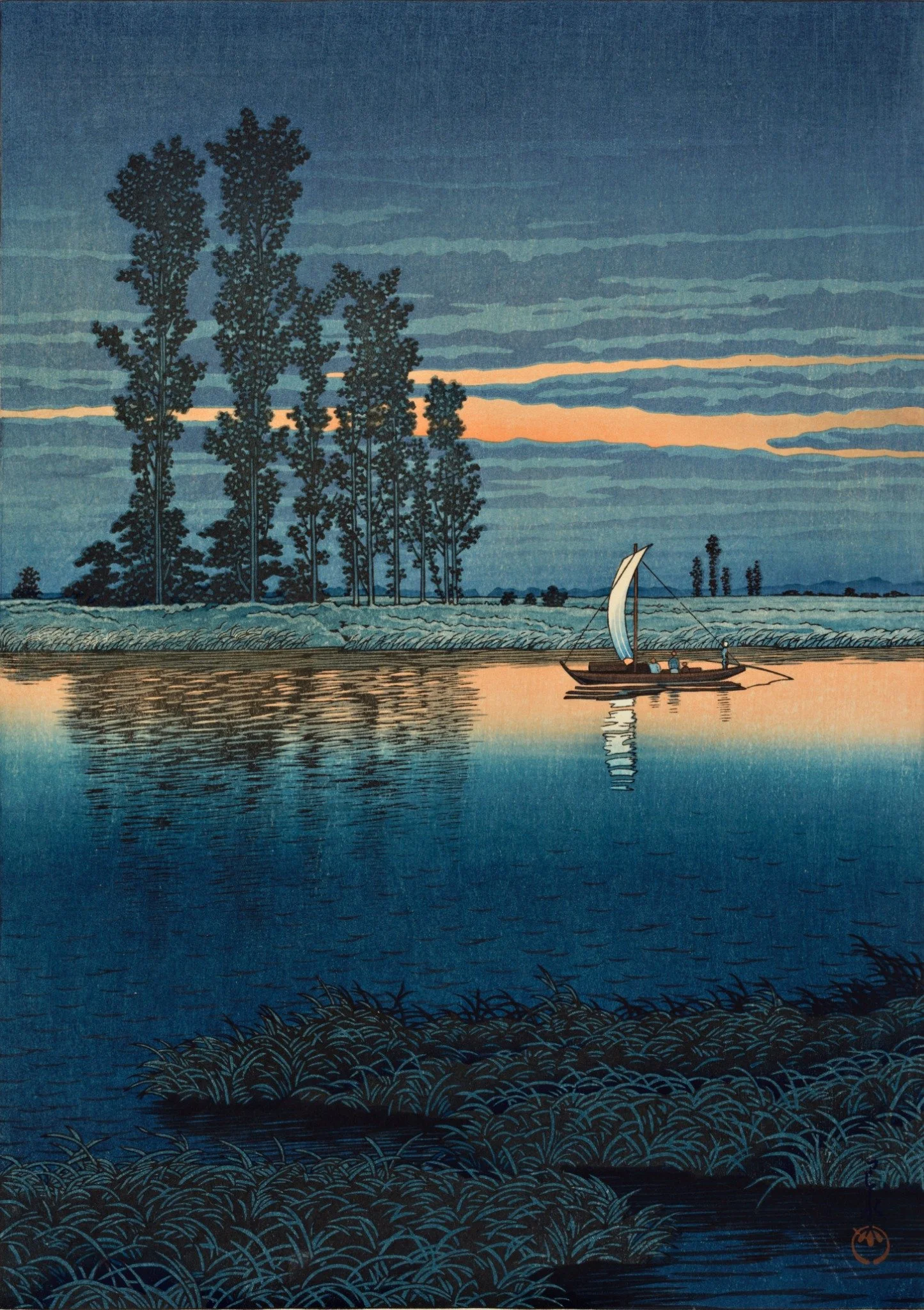
A white sail catches the last light as orange twilight opens between blue clouds and glows across the water. Kawase Hasui’s Evening at Ushibori brings the stillness of Japan’s riverside landscape into your home as a portrait canvas reproduction over a sturdy 1.5-inch wood stretcher.
| 16 × 24 in. | $259 CAD |
|---|---|
| 24 × 36 in. | $299 CAD |
Choose your canvas size and quantity below. All prices are in CAD.
Artwork titles and dates identify the original work. Review the product details and available options before ordering.
Ask about this print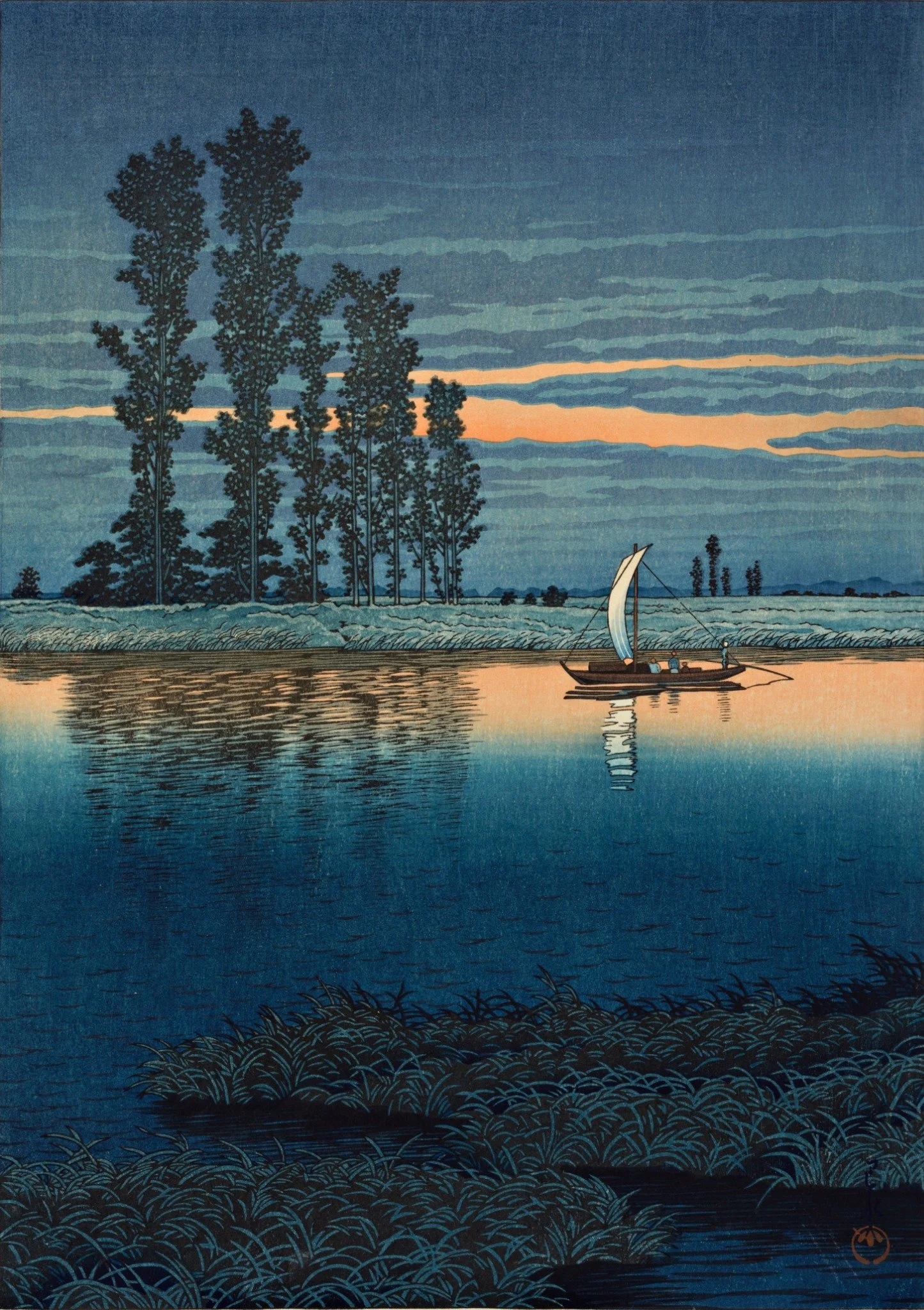
Premium quality canvas print of “Evening at Ushibori” by Kawase Hasui
A white sail catches the last light as orange twilight opens between blue clouds and glows across the water. Kawase Hasui’s Evening at Ushibori brings the stillness of Japan’s riverside landscape into your home as a portrait canvas reproduction over a sturdy 1.5-inch wood stretcher.
Product details: Canvas reproduction over a sturdy 1.5-inch wood stretcher. Available in 16 × 24 in. ($259 CAD) and 24 × 36 in. ($299 CAD). No returns accepted.
More About the Art
Evening at Ushibori gathers the changing colours of dusk around a small sailing boat. Its pale, curved sail rises against the far bank, catching the eye within a landscape of deep blues, dark trees, and rippling water. Above it, long cloud bands part to reveal a warm orange sky. The same colour spreads across the water beside the vessel, connecting the last light overhead with the quiet activity below.
The composition is unusually spacious for a vertical image. A low, nearly level bank divides the sky from the water, while much of the foreground remains open. Across that bank, a group of tall, slender trees rises at the left. Their narrow trunks, irregular crowns, and changing heights form a delicate screen against the sky. Smaller trees extend the rhythm toward the right without interrupting the broad expanse around the boat. The long horizon allows the eye to move slowly across the scene.
Closer to the viewer, dense clumps of reeds enter from the lower edge. Their pointed leaves curve outward in overlapping strokes, with pale blue accents separating individual blades from the darker growth beneath. Small channels of water wind between them. This intricate foreground gives the view a tangible shoreline and creates a quiet counterweight to the more distant, upright trees.
The boat rests slightly right of centre. Its dark hull carries several small figures, including a standing boatman at the right, and slender lines connect the mast with the vessel. The white sail curves into the breeze and returns below as a broken reflection. The figures are modest in scale, yet they give the surrounding water a human dimension. Their presence suggests a familiar passage through a landscape whose evening light is already changing.
Reflections make that change visible. Beneath the tall trees, short dark strokes gather into broad, wavering columns. Below the sail, pale marks descend in an irregular line. The warm band surrounding the boat dissolves gradually into cooler blue, while small curves and dashes animate the nearer surface. These repeated horizontal marks hold the water together without making it feel still or flat.
Hasui designed Evening at Ushibori in 1930, during the fifth year of the Shōwa era. Its Japanese title, Ushibori no yūgure, is written 牛堀の夕暮; it is also known in English as Dusk at Ushibori or Twilight at Ushibori. The original publication was by Sakai–Kawaguchi. Museum collections and surviving impressions preserve this independent design as part of Hasui’s wider exploration of Japan’s waterways.
Ushibori is now part of Itako in Ibaraki Prefecture, a region shaped by lakes and rivers. Hasui’s view gives particular attention to its meeting of vegetation, open water, and a low horizon. The orange light brings warmth to the surrounding blue, while the solitary sail provides a clear focal point. This canvas reproduction preserves the complete vertical image composition, allowing the foreground reeds, distant trees, sail, clouds, and reflections to remain in balance. Its rich colour and patient arrangement offer a place for the eye to pause, whether seen across a room or studied at close range.
More About the Artist
Kawase Hasui (1883–1957) was a Japanese artist whose colour woodblock landscapes give particular attention to the experience of a place under changing light and weather. His subjects range from temple grounds and city waterways to mountain villages, country roads, and coastal views. Evening at Ushibori, designed in 1930, shows how closely he could connect a small human presence with a wide landscape through silhouette, colour, and reflection.
Born in Tokyo with the given name Bunjiro, Hasui developed his art through more than one form of training. He studied Western-style painting under Okada Saburosuke and, in 1910, entered the studio of the Japanese-style painter Kaburaki Kiyokata. Kiyokata gave him the artist’s name Hasui. His early working life also included illustrations and commercial designs, experience that helped him organize an image with clear, engaging forms.
An important turn came through the landscape prints of Itō Shinsui, another artist associated with Kiyokata’s studio. Hasui began working with the publisher Watanabe Shōzaburō in 1918. That collaboration became central to shin-hanga, or “new prints,” a renewal of Japanese woodblock production during the early twentieth century. Established craft skills were retained while artists explored new combinations of observed scenery, tonal depth, and atmospheric effects.
Travel and sketching supplied much of Hasui’s subject matter. He journeyed widely across Japan, making records of places that later became finished print designs. Museums have emphasized his interest in quieter locations as well as famous landmarks. A stand of trees, a bend of water, or a familiar road could become a compelling subject when seen in particular conditions. His landscapes often invite attention to such relationships between ordinary surroundings and a brief moment of light.
Although Watanabe was his principal publishing partner, Hasui also designed prints for other firms. Evening at Ushibori was originally issued by Sakai–Kawaguchi, the partnership of Sakai Shōichi and Kawaguchi Jirō. This publication history forms part of the variety within his career. The 1930 design retains his characteristic clarity of place while giving exceptional prominence to a white sail, dark trees, and a narrow band of warm twilight.
The finished woodblock print was a collaborative achievement. An artist’s design passed through the hands of specialist carvers and printers, with the publisher coordinating production. In the Ushibori design, the tall trees, fine reeds, small figures, and broad changes of colour called for different kinds of attention. Their coherence depends on both the arrangement of the image and the craft that gave its lines and colour passages a material form.
Hasui’s career continued through substantial disruption. The Great Kantō Earthquake of 1923 destroyed his home and sketchbooks as well as Watanabe’s premises and early print stock. He resumed travelling and producing designs, and remained active after the Second World War. His work ultimately encompassed more than six hundred prints. In 1953, the making of Snow at Zōjōji Temple was documented by Japan’s Cultural Properties Protection Committee, recording the coordinated skills involved in traditional print production.
The appeal of Evening at Ushibori lies in the care with which its parts remain distinct within a shared atmosphere. The boat and reeds provide nearby detail, while the low bank and layered clouds open the view into the distance. Hasui gives the changing light a structure that can be explored repeatedly. The scene remains recognizable and immediate, yet its carefully paced forms leave room for a quiet, sustained encounter with the landscape.
Sources
Museum of Fine Arts, Boston — Evening at Ushibori; title, artist and Sakai–Kawaguchi publisher
Art Institute of Chicago — Dusk at Ushibori; museum collection record
Unsōdō — Twilight at Ushibori; Japanese title and first-publication year 1930
Itako City — Regional geography and the union of Itako and Ushibori
British Museum — Kawase Hasui biography and printmaking career
Tokyo Fuji Art Museum — Kawase Hasui biography and the 1953 documentation of woodblock production
Premium quality canvas print of “Evening at Ushibori” by Kawase Hasui
A white sail catches the last light as orange twilight opens between blue clouds and glows across the water. Kawase Hasui’s Evening at Ushibori brings the stillness of Japan’s riverside landscape into your home as a portrait canvas reproduction over a sturdy 1.5-inch wood stretcher.
Product details: Canvas reproduction over a sturdy 1.5-inch wood stretcher. Available in 16 × 24 in. ($259 CAD) and 24 × 36 in. ($299 CAD). No returns accepted.
More About the Art
Evening at Ushibori gathers the changing colours of dusk around a small sailing boat. Its pale, curved sail rises against the far bank, catching the eye within a landscape of deep blues, dark trees, and rippling water. Above it, long cloud bands part to reveal a warm orange sky. The same colour spreads across the water beside the vessel, connecting the last light overhead with the quiet activity below.
The composition is unusually spacious for a vertical image. A low, nearly level bank divides the sky from the water, while much of the foreground remains open. Across that bank, a group of tall, slender trees rises at the left. Their narrow trunks, irregular crowns, and changing heights form a delicate screen against the sky. Smaller trees extend the rhythm toward the right without interrupting the broad expanse around the boat. The long horizon allows the eye to move slowly across the scene.
Closer to the viewer, dense clumps of reeds enter from the lower edge. Their pointed leaves curve outward in overlapping strokes, with pale blue accents separating individual blades from the darker growth beneath. Small channels of water wind between them. This intricate foreground gives the view a tangible shoreline and creates a quiet counterweight to the more distant, upright trees.
The boat rests slightly right of centre. Its dark hull carries several small figures, including a standing boatman at the right, and slender lines connect the mast with the vessel. The white sail curves into the breeze and returns below as a broken reflection. The figures are modest in scale, yet they give the surrounding water a human dimension. Their presence suggests a familiar passage through a landscape whose evening light is already changing.
Reflections make that change visible. Beneath the tall trees, short dark strokes gather into broad, wavering columns. Below the sail, pale marks descend in an irregular line. The warm band surrounding the boat dissolves gradually into cooler blue, while small curves and dashes animate the nearer surface. These repeated horizontal marks hold the water together without making it feel still or flat.
Hasui designed Evening at Ushibori in 1930, during the fifth year of the Shōwa era. Its Japanese title, Ushibori no yūgure, is written 牛堀の夕暮; it is also known in English as Dusk at Ushibori or Twilight at Ushibori. The original publication was by Sakai–Kawaguchi. Museum collections and surviving impressions preserve this independent design as part of Hasui’s wider exploration of Japan’s waterways.
Ushibori is now part of Itako in Ibaraki Prefecture, a region shaped by lakes and rivers. Hasui’s view gives particular attention to its meeting of vegetation, open water, and a low horizon. The orange light brings warmth to the surrounding blue, while the solitary sail provides a clear focal point. This canvas reproduction preserves the complete vertical image composition, allowing the foreground reeds, distant trees, sail, clouds, and reflections to remain in balance. Its rich colour and patient arrangement offer a place for the eye to pause, whether seen across a room or studied at close range.
More About the Artist
Kawase Hasui (1883–1957) was a Japanese artist whose colour woodblock landscapes give particular attention to the experience of a place under changing light and weather. His subjects range from temple grounds and city waterways to mountain villages, country roads, and coastal views. Evening at Ushibori, designed in 1930, shows how closely he could connect a small human presence with a wide landscape through silhouette, colour, and reflection.
Born in Tokyo with the given name Bunjiro, Hasui developed his art through more than one form of training. He studied Western-style painting under Okada Saburosuke and, in 1910, entered the studio of the Japanese-style painter Kaburaki Kiyokata. Kiyokata gave him the artist’s name Hasui. His early working life also included illustrations and commercial designs, experience that helped him organize an image with clear, engaging forms.
An important turn came through the landscape prints of Itō Shinsui, another artist associated with Kiyokata’s studio. Hasui began working with the publisher Watanabe Shōzaburō in 1918. That collaboration became central to shin-hanga, or “new prints,” a renewal of Japanese woodblock production during the early twentieth century. Established craft skills were retained while artists explored new combinations of observed scenery, tonal depth, and atmospheric effects.
Travel and sketching supplied much of Hasui’s subject matter. He journeyed widely across Japan, making records of places that later became finished print designs. Museums have emphasized his interest in quieter locations as well as famous landmarks. A stand of trees, a bend of water, or a familiar road could become a compelling subject when seen in particular conditions. His landscapes often invite attention to such relationships between ordinary surroundings and a brief moment of light.
Although Watanabe was his principal publishing partner, Hasui also designed prints for other firms. Evening at Ushibori was originally issued by Sakai–Kawaguchi, the partnership of Sakai Shōichi and Kawaguchi Jirō. This publication history forms part of the variety within his career. The 1930 design retains his characteristic clarity of place while giving exceptional prominence to a white sail, dark trees, and a narrow band of warm twilight.
The finished woodblock print was a collaborative achievement. An artist’s design passed through the hands of specialist carvers and printers, with the publisher coordinating production. In the Ushibori design, the tall trees, fine reeds, small figures, and broad changes of colour called for different kinds of attention. Their coherence depends on both the arrangement of the image and the craft that gave its lines and colour passages a material form.
Hasui’s career continued through substantial disruption. The Great Kantō Earthquake of 1923 destroyed his home and sketchbooks as well as Watanabe’s premises and early print stock. He resumed travelling and producing designs, and remained active after the Second World War. His work ultimately encompassed more than six hundred prints. In 1953, the making of Snow at Zōjōji Temple was documented by Japan’s Cultural Properties Protection Committee, recording the coordinated skills involved in traditional print production.
The appeal of Evening at Ushibori lies in the care with which its parts remain distinct within a shared atmosphere. The boat and reeds provide nearby detail, while the low bank and layered clouds open the view into the distance. Hasui gives the changing light a structure that can be explored repeatedly. The scene remains recognizable and immediate, yet its carefully paced forms leave room for a quiet, sustained encounter with the landscape.
Sources for the artwork and artist
- Museum of Fine Arts, Boston — Evening at Ushibori; title, artist and Sakai–Kawaguchi publisher
- Art Institute of Chicago — Dusk at Ushibori; museum collection record
- Christie’s — Ushibori no yugure; 1930 design and original publishers Kawaguchi Jiro and Sakai Shoichi
- Unsōdō — Twilight at Ushibori; Japanese title and first-publication year 1930
- Kawase Hasui Catalogue — Twilight at Ushibori; Japanese title, date, publisher and production details
- Itako City — Regional geography and the union of Itako and Ushibori
- British Museum — Kawase Hasui biography and printmaking career
- Japan Museum SieboldHuis — Kawase Hasui: Capturing the Soul of Japan; travel, collaboration and career
- Tokyo Fuji Art Museum — Kawase Hasui biography and the 1953 documentation of woodblock production
- Sompo Museum of Art — Kawase Hasui: Travel and Nostalgic Landscape; landscape practice and shin-hanga context