
Japanese art on canvas
Cherry Blossoms
Toshi Yoshida · 1970
From $259 CAD
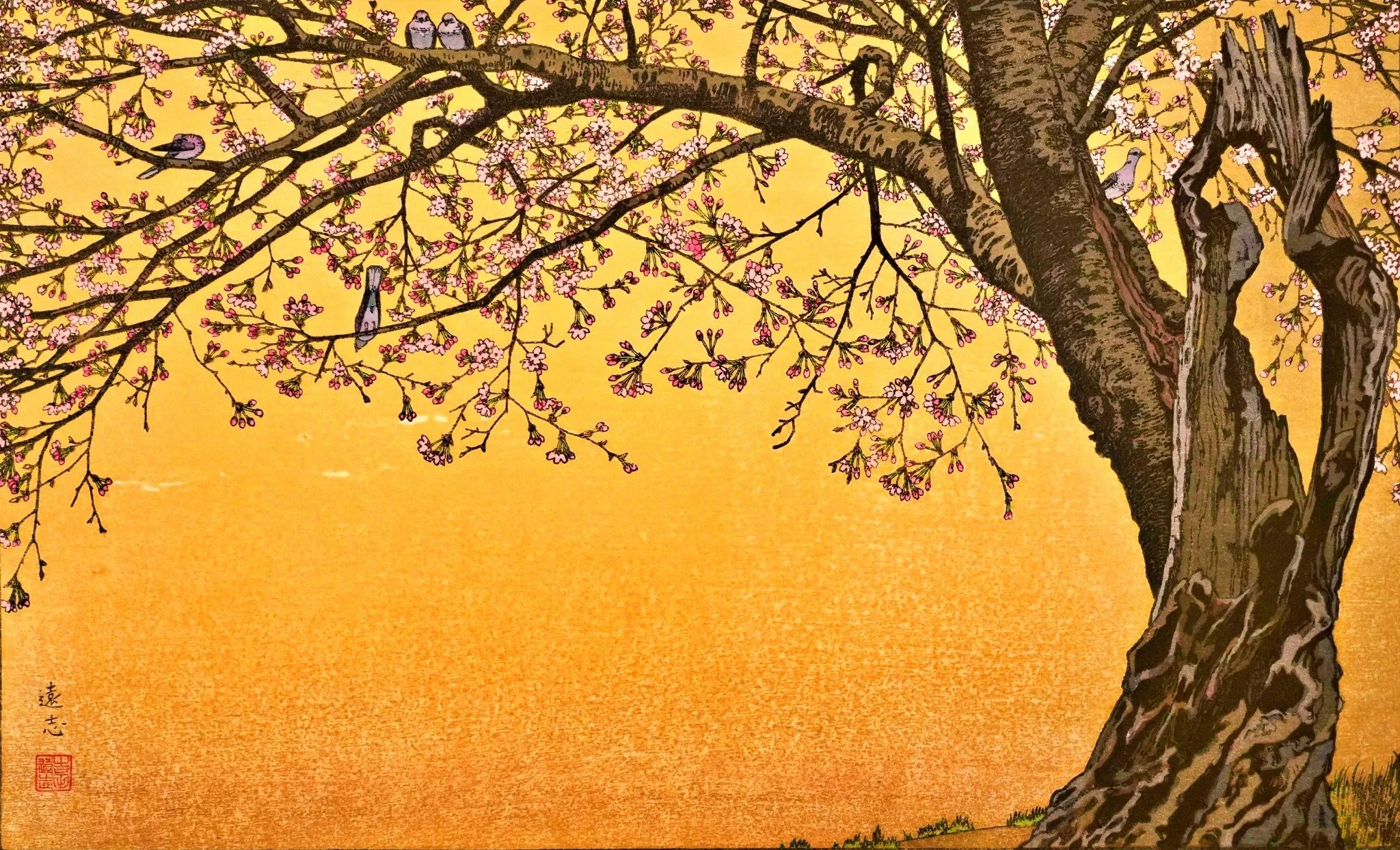
A venerable cherry tree unfolds pink blossoms and quiet birds across a glowing golden yellow background. Toshi Yoshida’s Cherry Blossoms brings the warmth and gentle promise of spring to a landscape canvas reproduction over a sturdy 1.5-inch wood stretcher.
| 24 × 16 in. | $259 CAD |
|---|---|
| 36 × 24 in. | $299 CAD |
Choose your canvas size and quantity below. All prices are in CAD.
Artwork titles and dates identify the original work. Review the product details and available options before ordering.
Ask about this print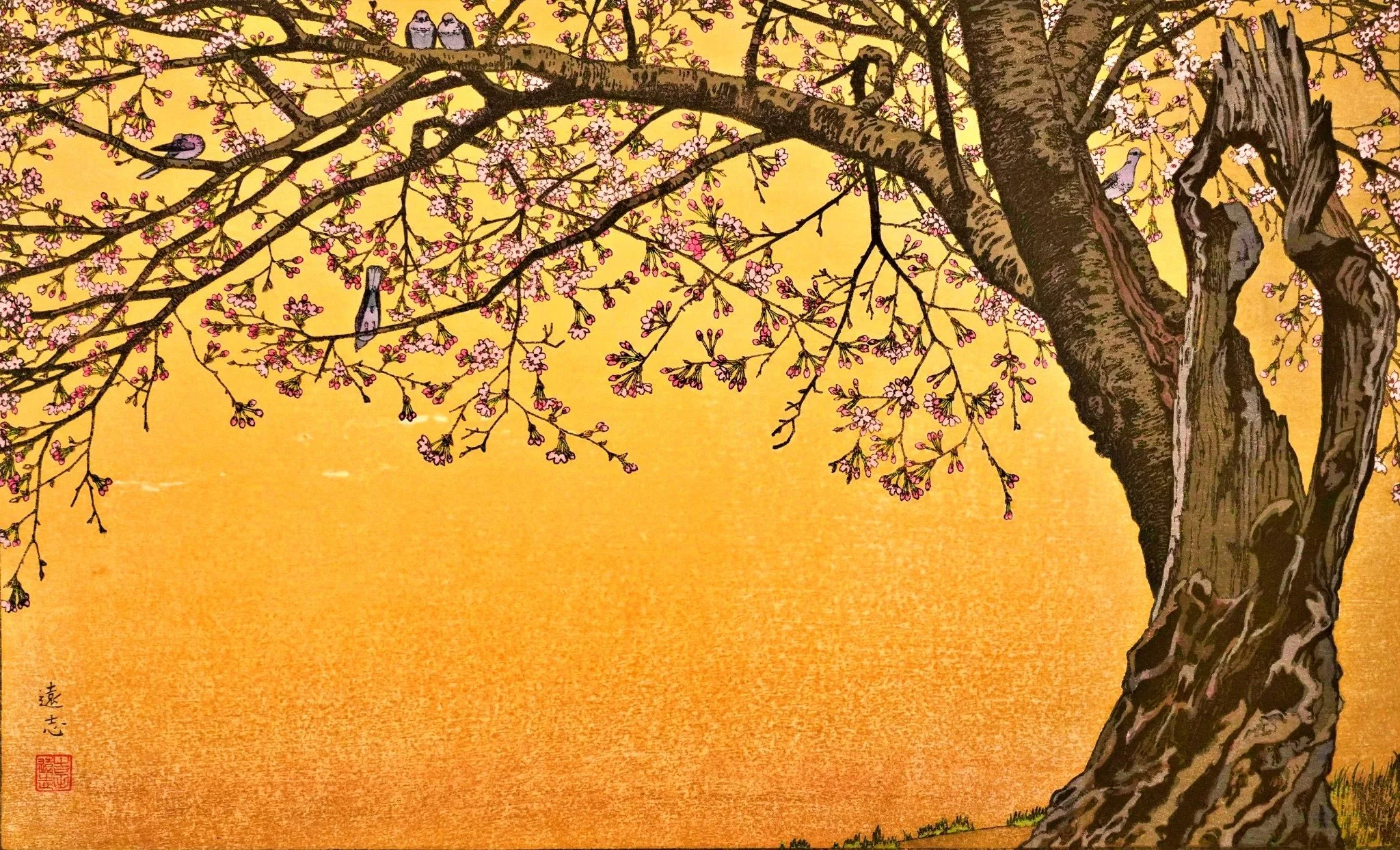
Premium quality canvas print of “Cherry Blossoms” by Toshi Yoshida
A venerable cherry tree unfolds pink blossoms and quiet birds across a glowing golden yellow background. Toshi Yoshida’s Cherry Blossoms brings the warmth and gentle promise of spring to a landscape canvas reproduction over a sturdy 1.5-inch wood stretcher.
Product details: Canvas reproduction over a sturdy 1.5-inch wood stretcher. Available in 24 × 16 in. ($259 CAD) and 36 × 24 in. ($299 CAD). No returns accepted.
More About the Art
Cherry Blossoms presents spring as a meeting of enduring strength and delicate renewal. A magnificent trunk rises along the right edge, its bark marked by deep grooves, pale streaks, and dark hollows. From this substantial base, branches stretch across the upper picture, carrying a network of slender twigs, pink buds, and newly opened flowers. The tree feels both ancient and freshly alive, holding the weight of many seasons while offering another quiet flowering.
The composition moves gently from density into openness. Thick limbs sweep from right to left, dividing into finer lines until the smallest stems almost dissolve into blossom. Beneath them, a broad field of warm yellow and amber gives the eye room to rest. This luminous background has little suggestion of a conventional horizon. It works as a spacious setting for the tree, allowing every curve, cluster of flowers, and small bird to remain distinct.
Several birds inhabit the branches. A pair sits close together near the upper centre, while others occupy more solitary perches among the twigs. Their soft grey and violet tones settle comfortably beside the dark bark and pink flowers. They introduce a living scale: the trunk becomes more monumental when measured against their compact bodies. Their stillness also slows the scene, suggesting a moment in which spring can be noticed without interruption.
Toshi Yoshida designed Cherry Blossoms in 1970. Its Japanese title, 三分咲き, refers to a stage when the flowers are only partly open. Buds remain visible throughout the canopy, so the image offers the pleasure of anticipation as well as the beauty of bloom. The English title appears in publisher catalogues, while the Cincinnati Art Museum records the work as a colour woodcut of 1970. It belongs to Yoshida’s mature engagement with the natural world.
The original design was created as a colour woodblock print and published through Yoshida. The contrast between broad colour and precise linear detail is especially effective here. Changes in the bark are described with interlocking shapes, while the flowers are gathered into small, legible groups. The warm background brings those details forward without requiring a distant landscape, a building, or a human figure to explain the setting. The tree itself supplies the entire visual experience.
There is a tender balance between the old trunk and the fragile flowers. Rough surfaces, broken wood, and twisting growth remain visible beside the lightest petals. Seen together, they suggest continuity rather than a perfect, untouched nature. The image can be enjoyed simply for its colour and rhythm, or considered more slowly as a reflection on time: brief blossoms returning to a tree whose character has developed through years of growth.
This UnitedArts canvas reproduction follows the supplied image, with its rich golden yellow field, rosy blossoms, small birds, and deeply textured tree. The landscape format gives the branches space to unfold, creating a warm focal point for a living room, dining area, or quiet reading space. Reproduced on canvas over a sturdy 1.5-inch wood stretcher, the composition brings the intimacy of a spring encounter into the everyday surroundings of a home.
More About the Artist
Toshi Yoshida (1911–1995) was a Japanese painter and printmaker whose work moved between landscape, abstraction, and the observation of animals. Born in Tokyo to artists Hiroshi Yoshida and Fujio Yoshida, he grew up within a household where art was part of daily life. His father’s studio introduced him to the demanding stages of traditional woodblock production, while his later career revealed a sustained desire to explore subjects and forms on his own terms.
He learned woodblock techniques from his father and the skilled artisans working around him. He also studied painting through the Pacific Painting Association. His early prints often show an affinity with Hiroshi’s naturalistic landscapes, but the relationship between their work was never entirely simple. The Mount Holyoke College Art Museum has drawn attention to Toshi’s particular clarity of detail and his own sense of tranquillity, even in subjects that initially appear close to his father’s.
Travel expanded his artistic outlook. As a young man he accompanied Hiroshi on journeys in Asia, and he continued to travel extensively throughout his life. Landscapes, plants, and wildlife encountered abroad entered his visual vocabulary. The Muscarelle Museum of Art has emphasized the breadth of these journeys, including Canada, India, China, Argentina, Italy, Kenya, Tanzania, and the United States. His work therefore reaches beyond a single image of Japan, while remaining closely connected to Japanese printmaking practice.
After Hiroshi’s death in 1950, Toshi took over the family studio. He also pursued new directions beyond the naturalistic style associated with its earlier work. In the early 1950s he began making abstract prints, investigating relationships between colour, line, texture, and shape. These experiments connect him with sōsaku-hanga, the creative print movement that emphasized the artist’s personal engagement with the making of a print. His career crossed the boundaries that can make such movement names seem rigid.
The abstract and descriptive sides of his work offer complementary ways of seeing. Mount Holyoke’s exhibition guide discusses his changing use of outline and volume, as well as the increasing freedom of his abstract compositions. MoMA’s collection includes several numbered works from 1952, evidence of this important part of his practice. Looking at Cherry Blossoms, one can appreciate a related sensitivity to structure: the dark branching pattern and expansive background remain compelling before individual flowers are examined.
Animals became especially important to his later work. His journeys to East Africa and other regions provided material for prints that considered wildlife within its surroundings. He also wrote and illustrated books about animals. The Tokyo National Research Institute for Cultural Properties records both this work and the cultural centre he established in Miasa, Nagano, in 1980, where woodblock printing and other crafts could be taught. Making art and sharing knowledge remained closely connected activities.
His educational role extended abroad through lectures and demonstrations of Japanese printmaking. This willingness to explain the medium helped sustain interest in its techniques across cultures. It also places his familiar, inviting images within a larger life of experimentation and exchange. A quiet tree or a small bird was never necessarily a modest ambition: such subjects allowed him to bring close observation together with the disciplined organisation of an entire picture.
Today his prints are held by institutions including the British Museum, MoMA, and the Cincinnati Art Museum. Cherry Blossoms offers a particularly approachable entrance to his work. Its beauty rests in carefully judged relationships between strength and delicacy, pattern and open space. The birds and buds reward close attention, while the spreading tree gives the whole image a calm assurance. These qualities help explain why Yoshida’s art continues to speak to viewers across generations.
Sources for the artwork and artist
Premium quality canvas print of “Cherry Blossoms” by Toshi Yoshida
A venerable cherry tree unfolds pink blossoms and quiet birds across a glowing golden yellow background. Toshi Yoshida’s Cherry Blossoms brings the warmth and gentle promise of spring to a landscape canvas reproduction over a sturdy 1.5-inch wood stretcher.
Product details: Canvas reproduction over a sturdy 1.5-inch wood stretcher. Available in 24 × 16 in. ($259 CAD) and 36 × 24 in. ($299 CAD). No returns accepted.
More About the Art
Cherry Blossoms presents spring as a meeting of enduring strength and delicate renewal. A magnificent trunk rises along the right edge, its bark marked by deep grooves, pale streaks, and dark hollows. From this substantial base, branches stretch across the upper picture, carrying a network of slender twigs, pink buds, and newly opened flowers. The tree feels both ancient and freshly alive, holding the weight of many seasons while offering another quiet flowering.
The composition moves gently from density into openness. Thick limbs sweep from right to left, dividing into finer lines until the smallest stems almost dissolve into blossom. Beneath them, a broad field of warm yellow and amber gives the eye room to rest. This luminous background has little suggestion of a conventional horizon. It works as a spacious setting for the tree, allowing every curve, cluster of flowers, and small bird to remain distinct.
Several birds inhabit the branches. A pair sits close together near the upper centre, while others occupy more solitary perches among the twigs. Their soft grey and violet tones settle comfortably beside the dark bark and pink flowers. They introduce a living scale: the trunk becomes more monumental when measured against their compact bodies. Their stillness also slows the scene, suggesting a moment in which spring can be noticed without interruption.
Toshi Yoshida designed Cherry Blossoms in 1970. Its Japanese title, 三分咲き, refers to a stage when the flowers are only partly open. Buds remain visible throughout the canopy, so the image offers the pleasure of anticipation as well as the beauty of bloom. The English title appears in publisher catalogues, while the Cincinnati Art Museum records the work as a colour woodcut of 1970. It belongs to Yoshida’s mature engagement with the natural world.
The original design was created as a colour woodblock print and published through Yoshida. The contrast between broad colour and precise linear detail is especially effective here. Changes in the bark are described with interlocking shapes, while the flowers are gathered into small, legible groups. The warm background brings those details forward without requiring a distant landscape, a building, or a human figure to explain the setting. The tree itself supplies the entire visual experience.
There is a tender balance between the old trunk and the fragile flowers. Rough surfaces, broken wood, and twisting growth remain visible beside the lightest petals. Seen together, they suggest continuity rather than a perfect, untouched nature. The image can be enjoyed simply for its colour and rhythm, or considered more slowly as a reflection on time: brief blossoms returning to a tree whose character has developed through years of growth.
This UnitedArts canvas reproduction follows the supplied image, with its rich golden yellow field, rosy blossoms, small birds, and deeply textured tree. The landscape format gives the branches space to unfold, creating a warm focal point for a living room, dining area, or quiet reading space. Reproduced on canvas over a sturdy 1.5-inch wood stretcher, the composition brings the intimacy of a spring encounter into the everyday surroundings of a home.
More About the Artist
Toshi Yoshida (1911–1995) was a Japanese painter and printmaker whose work moved between landscape, abstraction, and the observation of animals. Born in Tokyo to artists Hiroshi Yoshida and Fujio Yoshida, he grew up within a household where art was part of daily life. His father’s studio introduced him to the demanding stages of traditional woodblock production, while his later career revealed a sustained desire to explore subjects and forms on his own terms.
He learned woodblock techniques from his father and the skilled artisans working around him. He also studied painting through the Pacific Painting Association. His early prints often show an affinity with Hiroshi’s naturalistic landscapes, but the relationship between their work was never entirely simple. The Mount Holyoke College Art Museum has drawn attention to Toshi’s particular clarity of detail and his own sense of tranquillity, even in subjects that initially appear close to his father’s.
Travel expanded his artistic outlook. As a young man he accompanied Hiroshi on journeys in Asia, and he continued to travel extensively throughout his life. Landscapes, plants, and wildlife encountered abroad entered his visual vocabulary. The Muscarelle Museum of Art has emphasized the breadth of these journeys, including Canada, India, China, Argentina, Italy, Kenya, Tanzania, and the United States. His work therefore reaches beyond a single image of Japan, while remaining closely connected to Japanese printmaking practice.
After Hiroshi’s death in 1950, Toshi took over the family studio. He also pursued new directions beyond the naturalistic style associated with its earlier work. In the early 1950s he began making abstract prints, investigating relationships between colour, line, texture, and shape. These experiments connect him with sōsaku-hanga, the creative print movement that emphasized the artist’s personal engagement with the making of a print. His career crossed the boundaries that can make such movement names seem rigid.
The abstract and descriptive sides of his work offer complementary ways of seeing. Mount Holyoke’s exhibition guide discusses his changing use of outline and volume, as well as the increasing freedom of his abstract compositions. MoMA’s collection includes several numbered works from 1952, evidence of this important part of his practice. Looking at Cherry Blossoms, one can appreciate a related sensitivity to structure: the dark branching pattern and expansive background remain compelling before individual flowers are examined.
Animals became especially important to his later work. His journeys to East Africa and other regions provided material for prints that considered wildlife within its surroundings. He also wrote and illustrated books about animals. The Tokyo National Research Institute for Cultural Properties records both this work and the cultural centre he established in Miasa, Nagano, in 1980, where woodblock printing and other crafts could be taught. Making art and sharing knowledge remained closely connected activities.
His educational role extended abroad through lectures and demonstrations of Japanese printmaking. This willingness to explain the medium helped sustain interest in its techniques across cultures. It also places his familiar, inviting images within a larger life of experimentation and exchange. A quiet tree or a small bird was never necessarily a modest ambition: such subjects allowed him to bring close observation together with the disciplined organisation of an entire picture.
Today his prints are held by institutions including the British Museum, MoMA, and the Cincinnati Art Museum. Cherry Blossoms offers a particularly approachable entrance to his work. Its beauty rests in carefully judged relationships between strength and delicacy, pattern and open space. The birds and buds reward close attention, while the spreading tree gives the whole image a calm assurance. These qualities help explain why Yoshida’s art continues to speak to viewers across generations.
Sources for the artwork and artist
- Mokuhankan — Cherry Blossoms (三分咲き), Toshi Yoshida, Yoshida publisher and 1970 design; original-block reprinting context
- Unsodō — official catalogue listing for 三分咲き / Cherry Blossoms and Yoshida Studio printing
- Cincinnati Art Museum — 2015 Annual Report, accession 2013.102, Cherry Blossoms, 1970, colour woodcut
- British Museum — Yoshida Tōshi; training, travel, family studio and abstract printmaking
- Mount Holyoke College Art Museum — Yoshida Family Exhibition Guide; Toshi’s individual style, detail and abstraction
- Muscarelle Museum of Art — Tree to Mountain: The Woodblock Prints of Toshi Yoshida; travel, teaching and creative print context
- Tokyo National Research Institute for Cultural Properties — Yoshida Toshi, Japanese Art Yearbook obituary; family, animal subjects, books and Miasa cultural centre
- MoMA — Toshi Yoshida artist record and numbered abstract prints of 1952