
Japanese art on canvas
Benkeibashi Bridge, Akasaka
Shiro Kasamatsu · 1953
From $259 CAD
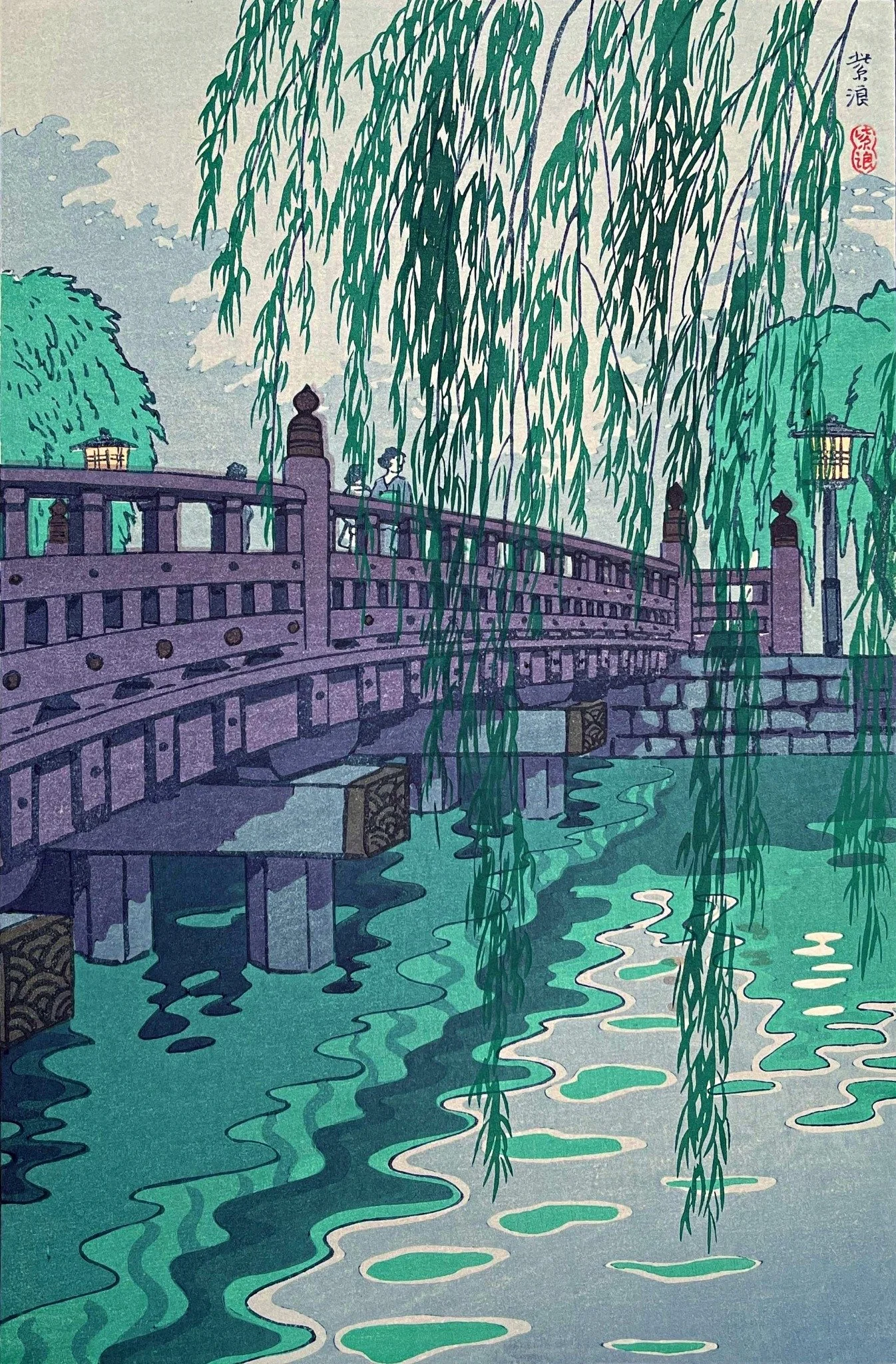
Willow branches fall across a violet bridge and luminous green water in Shiro Kasamatsu’s Benkeibashi Bridge, Akasaka. This portrait canvas reproduction brings the image’s delicate foliage, warm lanterns, and flowing reflections to your wall over a sturdy 1.5-inch wood stretcher.
| 16 × 24 in. | $259 CAD |
|---|---|
| 24 × 36 in. | $299 CAD |
Choose your canvas size and quantity below. All prices are in CAD.
Artwork titles and dates identify the original work. Review the product details and available options before ordering.
Ask about this print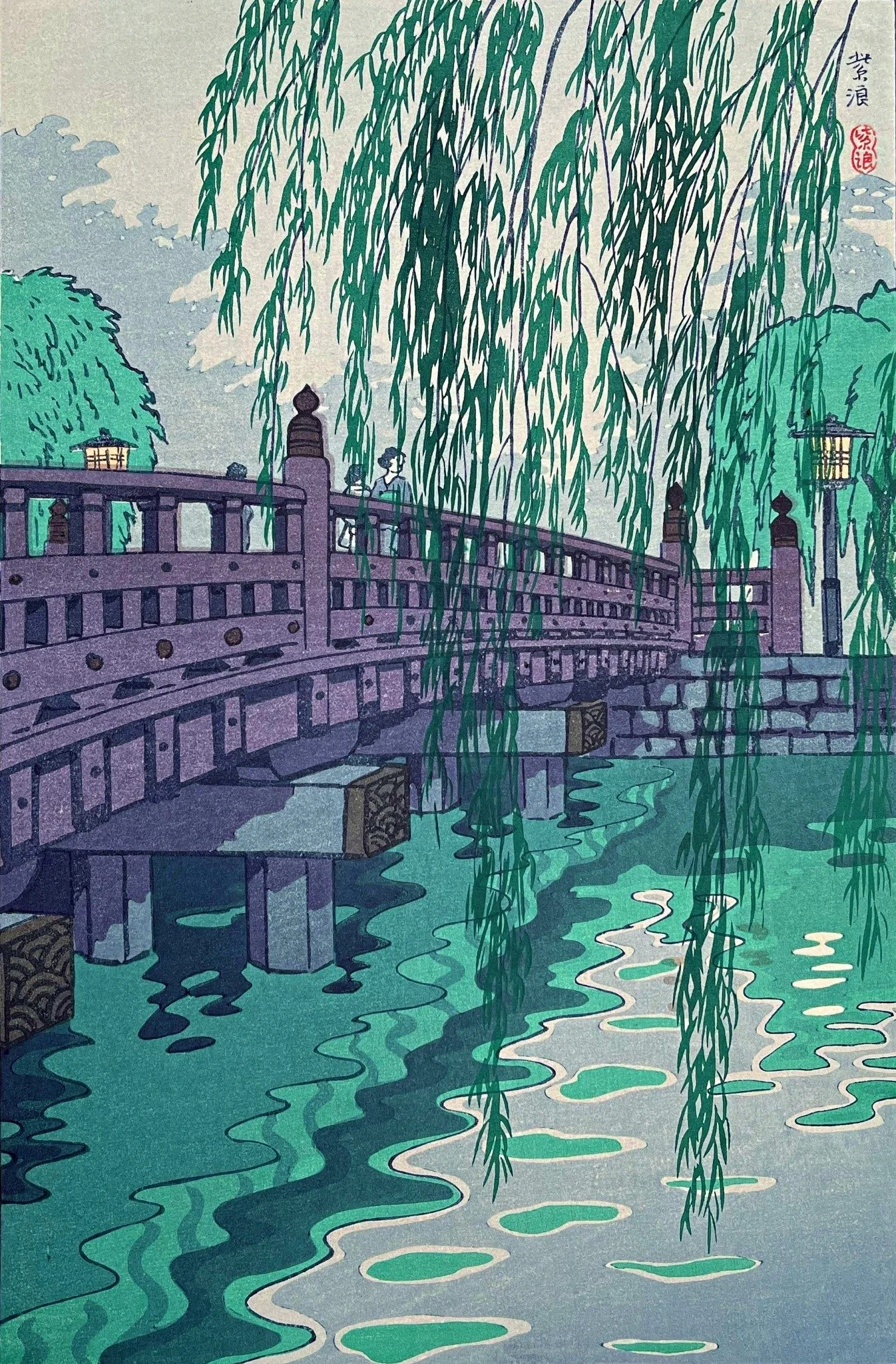
Premium quality canvas print of “Benkeibashi Bridge, Akasaka” by Shiro Kasamatsu
Willow branches fall across a violet bridge and luminous green water in Shiro Kasamatsu’s Benkeibashi Bridge, Akasaka. This portrait canvas reproduction brings the image’s delicate foliage, warm lanterns, and flowing reflections to your wall over a sturdy 1.5-inch wood stretcher.
Product details: Canvas reproduction over a sturdy 1.5-inch wood stretcher. Available in 16 × 24 in. ($259 CAD) and 24 × 36 in. ($299 CAD). No returns accepted.
More About the Art
A curtain of willow branches fills the foreground of Benkeibashi Bridge, Akasaka. Their long green leaves hang across the curve of a wooden bridge, allowing glimpses of two figures near its crest. Lanterns introduce small touches of warm yellow at either side. Below, the bridge's supports descend into water patterned with broad turquoise shapes and pale, winding reflections. The scene feels sheltered, as though the viewer is looking through foliage from a quiet position beside the bank.
Shiro Kasamatsu's design was first published in 1953. Unsōdō identifies it as part of Eight Views of Tokyo, while the Yamanashi Prefectural Museum of Art records the same title and date. Its Japanese title, Akasaka Benkeibashi, names the bridge and its Tokyo setting. The picture offers a particularly intimate way of encountering that location, bringing the hanging leaves so close that architecture and distant trees appear through their irregular openings.
The portrait format gives those leaves unusual importance. Some extend almost the full height of the image, connecting the sky with the water below. Their narrow, pointed forms vary in density: a dark cluster may be followed by a clearer interval through which a bridge post or lantern becomes visible. This alternation gives the foreground a sense of movement without requiring a single dramatic gesture. Looking through the willow becomes part of looking at the bridge itself.
Across this vertical screen, the bridge establishes a strong horizontal curve. Its violet rails and substantial posts are defined with firm dark lines. Rounded finials stand above the balustrade, while repeated divisions along the lower railing create a measured rhythm. The bridge is solid and carefully articulated, yet its edges are repeatedly interrupted by leaves. That relationship prevents the architecture from becoming isolated from its surroundings; it belongs within a larger world of foliage, light, and water.
The lower half changes the pace of the image. Reflections stretch and bend across the surface, turning upright supports into wavering bands of blue and green. Pale ribbons gather toward the right and foreground, opening areas of light among the deeper colours. These forms are less regular than the bridge's structure, but they remain clearly organized. Their curves answer the hanging leaves above, linking two very different kinds of natural pattern.
The figures are small and partially screened. Their presence makes the bridge feel used, giving its size a human measure while leaving the atmosphere undisturbed. The lanterns add another quiet indication of daily life. Their yellow rectangles are modest within the composition, yet they become especially noticeable beside the cool violet wood and green foliage. Colour rather than narrative supplies the picture's most immediate contrast.
This canvas reproduction preserves the supplied image's full portrait composition. From a distance, the bridge and water form broad areas of violet and turquoise. At closer range, the willow leaves, railing details, and changing reflections offer many smaller relationships to discover. The appeal lies in that exchange between clarity and concealment: a familiar urban crossing becomes a place where the eye can pause, follow a line, and move gradually through layers of quiet colour.
More About the Artist
Shiro Kasamatsu (1898–1991) was a Japanese painter and print designer whose long career connected the early development of shin-hanga with its continued practice after the Second World War. Born in Tokyo, he became known for landscapes, city scenes, temple grounds, and hot spring towns. His images often make a place memorable through a particular condition of light or season. In Benkeibashi Bridge, Akasaka, the familiar structure of a bridge becomes inseparable from the curtain of willow leaves and the shifting colours of the water.
As a young artist, Kasamatsu studied Japanese painting under Kaburaki Kiyokata. This training placed him within a studio associated with several important modern print designers, including Kawase Hasui and Itō Shinsui. Although his teacher was especially celebrated for pictures of women, Kasamatsu developed a sustained interest in landscape. Buildings, trees, bridges, and the spaces between them supplied subjects in which he could explore both the identity of a place and the atmosphere surrounding it.
His first prints for the publisher Watanabe Shōzaburō appeared in 1919. Watanabe was a central organizer of shin-hanga, the renewed Japanese woodblock tradition that brought artists together with specialist carvers and printers. The resulting images depended on shared skills. A designer established the composition, while the carved blocks and carefully handled layers of pigment gave it material form. Kasamatsu's career began during the movement's formative years, when publishers and artists were developing new ways to present contemporary Japanese life through established printmaking methods.
The Ōta Memorial Museum of Art emphasizes his sensitive use of pale colour in views of Tokyo and hot spring areas. That restraint can be understood as a way of allowing architecture and weather to occupy the same image without one overwhelming the other. A street, roof, or distant hillside remains legible, while the surrounding air changes its appearance. His pictures reward attention to intervals as much as objects: an opening between branches, a stretch of water, or a softly coloured area of sky can become crucial to the composition.
After the war, Kasamatsu worked with the Kyoto publisher Unsōdō. The museum dates this important phase of his shin-hanga production to 1952–1959. Benkeibashi Bridge, Akasaka was first issued in 1953 as part of Eight Views of Tokyo. Its dense greenery and violet bridge show how decisively colour can organize a scene. Vertical leaves, curving rails, and broken reflections establish different rhythms, while small figures connect the architecture with everyday movement.
Kasamatsu also explored sōsaku-hanga, producing work through his own designing, carving, and printing. His career thus encompassed both the collaborative publishing tradition and a more individually controlled printmaking practice. This breadth helps place him within the changing history of twentieth-century Japanese prints. The Ōta Memorial Museum devoted a major exhibition to his shin-hanga in 2021, bringing together early and postwar works. Looking at his images today, the enduring attraction is their patient observation: ordinary paths, buildings, trees, and waterways become places where colour, craft, and quiet human experience meet. Each scene offers a different invitation to look closely and remain for a moment.
Premium quality canvas print of “Benkeibashi Bridge, Akasaka” by Shiro Kasamatsu
Willow branches fall across a violet bridge and luminous green water in Shiro Kasamatsu’s Benkeibashi Bridge, Akasaka. This portrait canvas reproduction brings the image’s delicate foliage, warm lanterns, and flowing reflections to your wall over a sturdy 1.5-inch wood stretcher.
Product details: Canvas reproduction over a sturdy 1.5-inch wood stretcher. Available in 16 × 24 in. ($259 CAD) and 24 × 36 in. ($299 CAD). No returns accepted.
More About the Art
A curtain of willow branches fills the foreground of Benkeibashi Bridge, Akasaka. Their long green leaves hang across the curve of a wooden bridge, allowing glimpses of two figures near its crest. Lanterns introduce small touches of warm yellow at either side. Below, the bridge's supports descend into water patterned with broad turquoise shapes and pale, winding reflections. The scene feels sheltered, as though the viewer is looking through foliage from a quiet position beside the bank.
Shiro Kasamatsu's design was first published in 1953. Unsōdō identifies it as part of Eight Views of Tokyo, while the Yamanashi Prefectural Museum of Art records the same title and date. Its Japanese title, Akasaka Benkeibashi, names the bridge and its Tokyo setting. The picture offers a particularly intimate way of encountering that location, bringing the hanging leaves so close that architecture and distant trees appear through their irregular openings.
The portrait format gives those leaves unusual importance. Some extend almost the full height of the image, connecting the sky with the water below. Their narrow, pointed forms vary in density: a dark cluster may be followed by a clearer interval through which a bridge post or lantern becomes visible. This alternation gives the foreground a sense of movement without requiring a single dramatic gesture. Looking through the willow becomes part of looking at the bridge itself.
Across this vertical screen, the bridge establishes a strong horizontal curve. Its violet rails and substantial posts are defined with firm dark lines. Rounded finials stand above the balustrade, while repeated divisions along the lower railing create a measured rhythm. The bridge is solid and carefully articulated, yet its edges are repeatedly interrupted by leaves. That relationship prevents the architecture from becoming isolated from its surroundings; it belongs within a larger world of foliage, light, and water.
The lower half changes the pace of the image. Reflections stretch and bend across the surface, turning upright supports into wavering bands of blue and green. Pale ribbons gather toward the right and foreground, opening areas of light among the deeper colours. These forms are less regular than the bridge's structure, but they remain clearly organized. Their curves answer the hanging leaves above, linking two very different kinds of natural pattern.
The figures are small and partially screened. Their presence makes the bridge feel used, giving its size a human measure while leaving the atmosphere undisturbed. The lanterns add another quiet indication of daily life. Their yellow rectangles are modest within the composition, yet they become especially noticeable beside the cool violet wood and green foliage. Colour rather than narrative supplies the picture's most immediate contrast.
This canvas reproduction preserves the supplied image's full portrait composition. From a distance, the bridge and water form broad areas of violet and turquoise. At closer range, the willow leaves, railing details, and changing reflections offer many smaller relationships to discover. The appeal lies in that exchange between clarity and concealment: a familiar urban crossing becomes a place where the eye can pause, follow a line, and move gradually through layers of quiet colour.
More About the Artist
Shiro Kasamatsu (1898–1991) was a Japanese painter and print designer whose long career connected the early development of shin-hanga with its continued practice after the Second World War. Born in Tokyo, he became known for landscapes, city scenes, temple grounds, and hot spring towns. His images often make a place memorable through a particular condition of light or season. In Benkeibashi Bridge, Akasaka, the familiar structure of a bridge becomes inseparable from the curtain of willow leaves and the shifting colours of the water.
As a young artist, Kasamatsu studied Japanese painting under Kaburaki Kiyokata. This training placed him within a studio associated with several important modern print designers, including Kawase Hasui and Itō Shinsui. Although his teacher was especially celebrated for pictures of women, Kasamatsu developed a sustained interest in landscape. Buildings, trees, bridges, and the spaces between them supplied subjects in which he could explore both the identity of a place and the atmosphere surrounding it.
His first prints for the publisher Watanabe Shōzaburō appeared in 1919. Watanabe was a central organizer of shin-hanga, the renewed Japanese woodblock tradition that brought artists together with specialist carvers and printers. The resulting images depended on shared skills. A designer established the composition, while the carved blocks and carefully handled layers of pigment gave it material form. Kasamatsu's career began during the movement's formative years, when publishers and artists were developing new ways to present contemporary Japanese life through established printmaking methods.
The Ōta Memorial Museum of Art emphasizes his sensitive use of pale colour in views of Tokyo and hot spring areas. That restraint can be understood as a way of allowing architecture and weather to occupy the same image without one overwhelming the other. A street, roof, or distant hillside remains legible, while the surrounding air changes its appearance. His pictures reward attention to intervals as much as objects: an opening between branches, a stretch of water, or a softly coloured area of sky can become crucial to the composition.
After the war, Kasamatsu worked with the Kyoto publisher Unsōdō. The museum dates this important phase of his shin-hanga production to 1952–1959. Benkeibashi Bridge, Akasaka was first issued in 1953 as part of Eight Views of Tokyo. Its dense greenery and violet bridge show how decisively colour can organize a scene. Vertical leaves, curving rails, and broken reflections establish different rhythms, while small figures connect the architecture with everyday movement.
Kasamatsu also explored sōsaku-hanga, producing work through his own designing, carving, and printing. His career thus encompassed both the collaborative publishing tradition and a more individually controlled printmaking practice. This breadth helps place him within the changing history of twentieth-century Japanese prints. The Ōta Memorial Museum devoted a major exhibition to his shin-hanga in 2021, bringing together early and postwar works. Looking at his images today, the enduring attraction is their patient observation: ordinary paths, buildings, trees, and waterways become places where colour, craft, and quiet human experience meet. Each scene offers a different invitation to look closely and remain for a moment.