
Japanese art on canvas
Autumn Moon over Katata
Katsuyuki Nishijima · Late 20th century
From $259 CAD
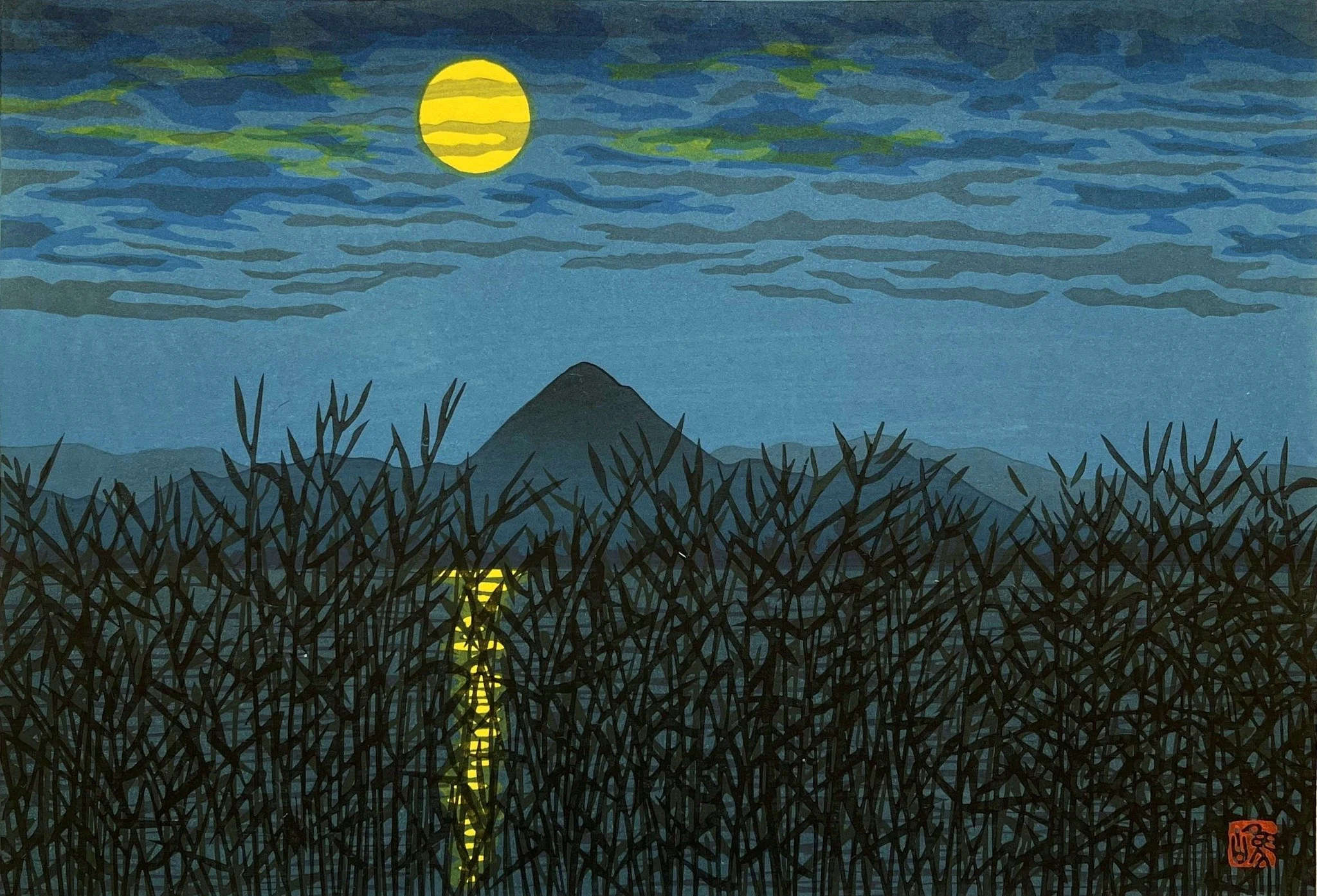
A bright yellow moon glows above layered blue hills, sending a narrow reflection through a dense screen of reeds. Katsuyuki Nishijima’s Autumn Moon over Katata brings rich nocturnal colour to a landscape canvas reproduction over a sturdy 1.5-inch wood stretcher.
| 24 × 16 in. | $259 CAD |
|---|---|
| 36 × 24 in. | $299 CAD |
Choose your canvas size and quantity below. All prices are in CAD.
Artwork titles and dates identify the original work. Review the product details and available options before ordering.
Ask about this print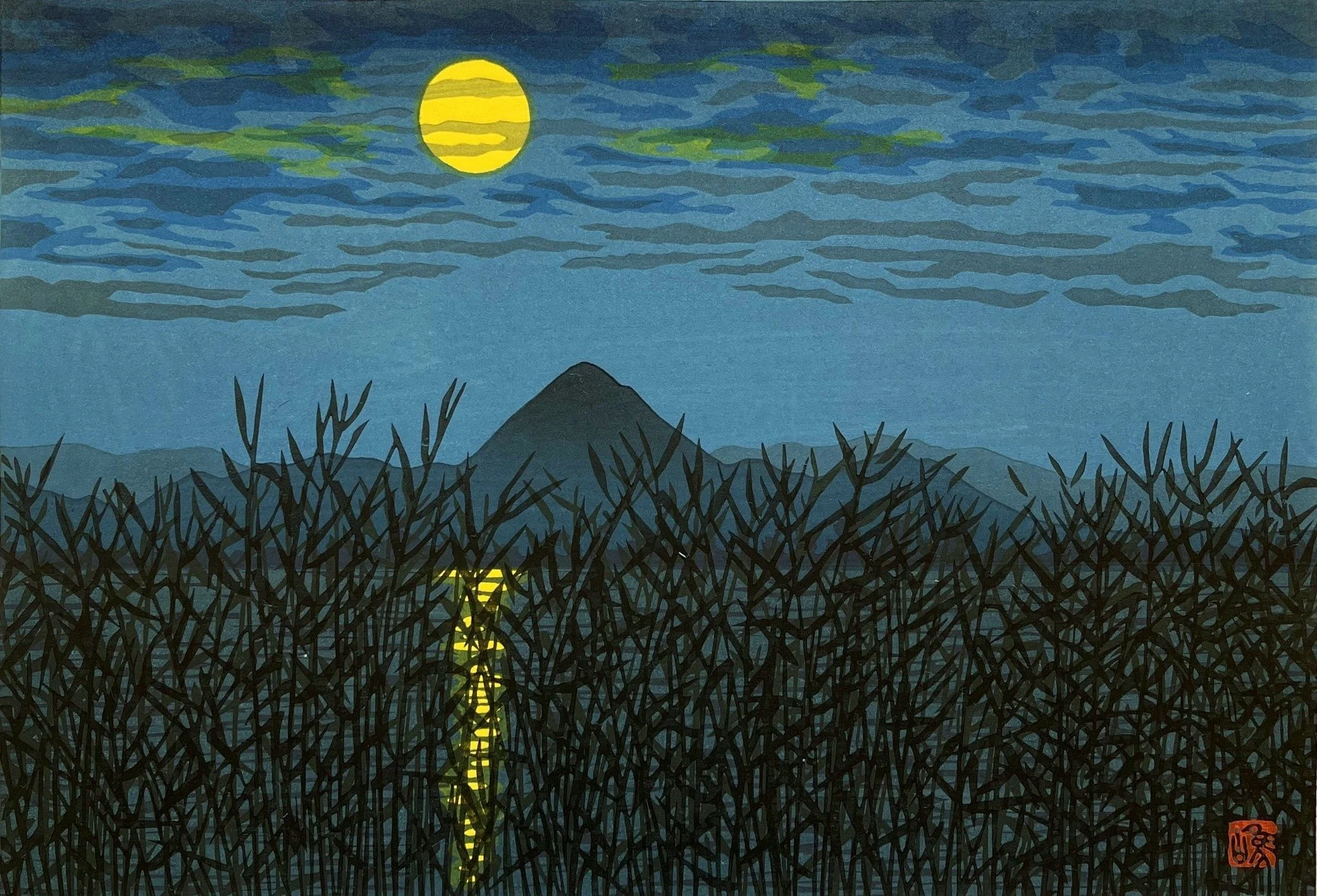
Premium quality canvas print of “Autumn Moon over Katata” by Katsuyuki Nishijima
A bright yellow moon glows above layered blue hills, sending a narrow reflection through a dense screen of reeds. Katsuyuki Nishijima’s Autumn Moon over Katata brings rich nocturnal colour to a landscape canvas reproduction over a sturdy 1.5-inch wood stretcher.
Product details: Canvas reproduction over a sturdy 1.5-inch wood stretcher. Available in 24 × 16 in. ($259 CAD) and 36 × 24 in. ($299 CAD). No returns accepted.
More About the Art
A yellow moon glows above the dark outline of a distant mountain in Autumn Moon over Katata. Long bands of cloud pass across its face and extend through the surrounding blue sky. Below, the moon's reflection appears in a narrow opening between dense reeds. The image brings a wide night landscape into an unusually intimate view: distant light is seen through a close network of leaves, stems, and sharply angled silhouettes.
Japanese Gallery records Katsuyuki Nishijima's Autumn Moon Over Katata as a late twentieth-century woodblock print. The title names Katata, a subject associated with his waterside landscapes. In the supplied image, the moon is fully visible above the horizon, while its broken reflection descends into the foreground growth. The complete moon provides a clear point of focus above the more intricate shapes below, establishing a calm relationship between sky, distance, and foreground.
The moon establishes the first point of attention. Its yellow disk is clear enough to stand apart from the cooler sky, but irregular cloud bands prevent it from appearing isolated. Some clouds are muted green-grey; others are deeper blue. Their long horizontal shapes spread the light across the composition and make the sky feel layered. The brightest colour remains concentrated around the moon and its reflection, giving the larger blue field a quiet centre.
The mountain below has a simple, almost triangular profile. Softer ridges extend outward to either side, with small changes of tone suggesting one layer behind another. These distant shapes are deliberately less intricate than the reeds. Their broad surfaces provide rest for the eye between the patterned sky and busy foreground. They also help connect the moon with the water, forming a clear middle distance through which the light seems to pass.
The reeds occupy much of the lower half. Their dark stems cross at varied angles, while long leaves bend and point into the open areas. Blue-green spaces remain between them, so the foreground never becomes a single opaque mass. The eye can follow an individual stem, discover a small interval of water, and then return to the central reflection. This movement makes the reeds feel both enclosing and permeable, a screen through which the wider landscape is gradually revealed.
The reflection introduces a slender vertical rhythm. Broken yellow marks descend through several openings, varying in width and intensity. Their irregular edges suggest light scattered across a moving surface. This small column links the moon to the lower edge without forming a rigid line. The surrounding reeds repeatedly interrupt it, allowing brightness and shadow to alternate within a concentrated area of the composition.
Presented on canvas, the supplied landscape image preserves the full moon, layered hills, and intricate reed screen. Its deep blues give it a cohesive presence from across a room, while the yellow accents keep the image luminous. Closer attention reveals how carefully the open spaces are distributed among the dark stems. The work offers a quiet encounter with night through the relationship between a distant source of light and the nearby forms that frame it.
More About the Artist
Katsuyuki Nishijima, born in Yamaguchi Prefecture in 1945, is a Japanese woodblock printmaker whose work brings close attention to traditional buildings and the landscapes around them. His subjects include shopfronts, tiled roofs, thatched farmhouses, waterways, and quiet stretches of town. Strong outlines and broad areas of colour give these familiar places an immediate presence. Small variations within roofs, walls, foliage, and sky then invite a slower kind of looking, revealing how much visual interest can be held within an apparently modest scene.
Nishijima trained at the Mikumo publishing house in Kyoto between 1964 and 1968. This period gave him sustained experience of woodblock printmaking and its practical demands. A print develops through the relationship between a design, the carved surfaces that carry it, and the colours transferred to paper. Learning that relationship requires attention to both the whole composition and the smallest marks. His later images show a particularly clear understanding of how large colour shapes and fine linear details can support one another.
During the second half of the 1960s, he exhibited with the Kyoto Independents. He also explored stencil dyeing and printing, especially between 1969 and 1972. From 1972, traditional architecture became a central subject in his limited edition woodblocks. His series include views associated with the Sixty-Nine Stations of the Kisokaidō and scenes of Kyoto streets. These projects place everyday buildings within a continuing Japanese tradition of looking closely at roads, settlements, and the distinctive appearance of particular places.
Nishijima's practice is associated with sōsaku-hanga, often translated as creative prints. This approach places the artist at the centre of designing, carving, and printing. The Philbrook Museum of Art describes the individual command of these stages as an essential quality of his work. His pictures therefore belong to a tradition in which the marks of the image emerge through an artist's sustained engagement with the material process, from the decisions of the initial design to the pressure and colour of the printed impression.
Traditional architecture offers him a remarkably varied visual language. Roof tiles can become closely repeated dark strokes; a plaster wall can provide a broad interval of light; wooden frames can divide a facade into strong geometric shapes. A street or bank may lead the eye into depth, while an overhanging tree closes part of the view. These are qualities visible across his work, and they help explain why a building or quiet landscape can carry a composition without relying on a dramatic event.
Human presence is often suggested through inhabited structures and traces of use. A doorway, a roofline, or a boat can give a setting a sense of ordinary life even when no figure occupies the scene. Nishijima's landscapes can be enjoyed both as recognizable places and as arrangements of colour and line. The two experiences reinforce each other: close looking makes the construction of the picture clearer, while also making the setting feel more particular. His woodblocks are represented in museum collections in Japan and abroad, including American institutions identified by the Philbrook Museum.
Premium quality canvas print of “Autumn Moon over Katata” by Katsuyuki Nishijima
A bright yellow moon glows above layered blue hills, sending a narrow reflection through a dense screen of reeds. Katsuyuki Nishijima’s Autumn Moon over Katata brings rich nocturnal colour to a landscape canvas reproduction over a sturdy 1.5-inch wood stretcher.
Product details: Canvas reproduction over a sturdy 1.5-inch wood stretcher. Available in 24 × 16 in. ($259 CAD) and 36 × 24 in. ($299 CAD). No returns accepted.
More About the Art
A yellow moon glows above the dark outline of a distant mountain in Autumn Moon over Katata. Long bands of cloud pass across its face and extend through the surrounding blue sky. Below, the moon's reflection appears in a narrow opening between dense reeds. The image brings a wide night landscape into an unusually intimate view: distant light is seen through a close network of leaves, stems, and sharply angled silhouettes.
Japanese Gallery records Katsuyuki Nishijima's Autumn Moon Over Katata as a late twentieth-century woodblock print. The title names Katata, a subject associated with his waterside landscapes. In the supplied image, the moon is fully visible above the horizon, while its broken reflection descends into the foreground growth. The complete moon provides a clear point of focus above the more intricate shapes below, establishing a calm relationship between sky, distance, and foreground.
The moon establishes the first point of attention. Its yellow disk is clear enough to stand apart from the cooler sky, but irregular cloud bands prevent it from appearing isolated. Some clouds are muted green-grey; others are deeper blue. Their long horizontal shapes spread the light across the composition and make the sky feel layered. The brightest colour remains concentrated around the moon and its reflection, giving the larger blue field a quiet centre.
The mountain below has a simple, almost triangular profile. Softer ridges extend outward to either side, with small changes of tone suggesting one layer behind another. These distant shapes are deliberately less intricate than the reeds. Their broad surfaces provide rest for the eye between the patterned sky and busy foreground. They also help connect the moon with the water, forming a clear middle distance through which the light seems to pass.
The reeds occupy much of the lower half. Their dark stems cross at varied angles, while long leaves bend and point into the open areas. Blue-green spaces remain between them, so the foreground never becomes a single opaque mass. The eye can follow an individual stem, discover a small interval of water, and then return to the central reflection. This movement makes the reeds feel both enclosing and permeable, a screen through which the wider landscape is gradually revealed.
The reflection introduces a slender vertical rhythm. Broken yellow marks descend through several openings, varying in width and intensity. Their irregular edges suggest light scattered across a moving surface. This small column links the moon to the lower edge without forming a rigid line. The surrounding reeds repeatedly interrupt it, allowing brightness and shadow to alternate within a concentrated area of the composition.
Presented on canvas, the supplied landscape image preserves the full moon, layered hills, and intricate reed screen. Its deep blues give it a cohesive presence from across a room, while the yellow accents keep the image luminous. Closer attention reveals how carefully the open spaces are distributed among the dark stems. The work offers a quiet encounter with night through the relationship between a distant source of light and the nearby forms that frame it.
More About the Artist
Katsuyuki Nishijima, born in Yamaguchi Prefecture in 1945, is a Japanese woodblock printmaker whose work brings close attention to traditional buildings and the landscapes around them. His subjects include shopfronts, tiled roofs, thatched farmhouses, waterways, and quiet stretches of town. Strong outlines and broad areas of colour give these familiar places an immediate presence. Small variations within roofs, walls, foliage, and sky then invite a slower kind of looking, revealing how much visual interest can be held within an apparently modest scene.
Nishijima trained at the Mikumo publishing house in Kyoto between 1964 and 1968. This period gave him sustained experience of woodblock printmaking and its practical demands. A print develops through the relationship between a design, the carved surfaces that carry it, and the colours transferred to paper. Learning that relationship requires attention to both the whole composition and the smallest marks. His later images show a particularly clear understanding of how large colour shapes and fine linear details can support one another.
During the second half of the 1960s, he exhibited with the Kyoto Independents. He also explored stencil dyeing and printing, especially between 1969 and 1972. From 1972, traditional architecture became a central subject in his limited edition woodblocks. His series include views associated with the Sixty-Nine Stations of the Kisokaidō and scenes of Kyoto streets. These projects place everyday buildings within a continuing Japanese tradition of looking closely at roads, settlements, and the distinctive appearance of particular places.
Nishijima's practice is associated with sōsaku-hanga, often translated as creative prints. This approach places the artist at the centre of designing, carving, and printing. The Philbrook Museum of Art describes the individual command of these stages as an essential quality of his work. His pictures therefore belong to a tradition in which the marks of the image emerge through an artist's sustained engagement with the material process, from the decisions of the initial design to the pressure and colour of the printed impression.
Traditional architecture offers him a remarkably varied visual language. Roof tiles can become closely repeated dark strokes; a plaster wall can provide a broad interval of light; wooden frames can divide a facade into strong geometric shapes. A street or bank may lead the eye into depth, while an overhanging tree closes part of the view. These are qualities visible across his work, and they help explain why a building or quiet landscape can carry a composition without relying on a dramatic event.
Human presence is often suggested through inhabited structures and traces of use. A doorway, a roofline, or a boat can give a setting a sense of ordinary life even when no figure occupies the scene. Nishijima's landscapes can be enjoyed both as recognizable places and as arrangements of colour and line. The two experiences reinforce each other: close looking makes the construction of the picture clearer, while also making the setting feel more particular. His woodblocks are represented in museum collections in Japan and abroad, including American institutions identified by the Philbrook Museum.